Well Pump Repair Cost Georgia (2026)
Well pump repair cost georgia homeowners pay ranges from $200 for minor fixes to $2,500+ for full pump replacement. See costs by repair type.
The well pump repair cost georgia homeowners face ranges from $200 for minor electrical fixes to $2,500 or more for a full submersible pump replacement. When your pump fails, your household has no water — no showers, no toilets, no cooking. That urgency means you need to know what to expect before the problem hits. Georgia's 450,000 to 560,000 private wells each depend on a pump to deliver water, and every pump eventually fails.
Georgia's EPD licenses well pump contractors separately from well drillers. Certified pump contractors must pass an exam, maintain a license, and complete continuing education. Hiring a licensed professional ensures the work is done safely and to code, particularly important because well pump work involves electrical systems, pressurized water, and potentially deep well shafts.
Well Pump Repair Cost Georgia: By Problem Type
Not every pump problem requires a full replacement. Here is what the well pump repair cost georgia homeowners pay for the most common issues.
| Repair Type | Typical Cost | Common Cause |
|---|---|---|
| Pressure switch replacement | $150–$350 | Switch contacts worn, incorrect cut-in/cut-out |
| Pressure tank replacement | $300–$800 | Bladder failure, waterlogging |
| Electrical repair (wiring, breaker) | $150–$400 | Lightning damage, corroded connections |
| Control box replacement | $200–$500 | Capacitor or relay failure |
| Submersible pump replacement | $1,000–$2,500+ | Motor burnout, impeller wear, age |
| Jet pump replacement | $500–$1,200 | Motor failure, less common in GA |
| Pitless adapter replacement | $200–$500 | Corrosion, freeze damage (rare in GA) |
| Well pipe repair/replacement | $300–$1,500 | Corrosion, damaged connections |
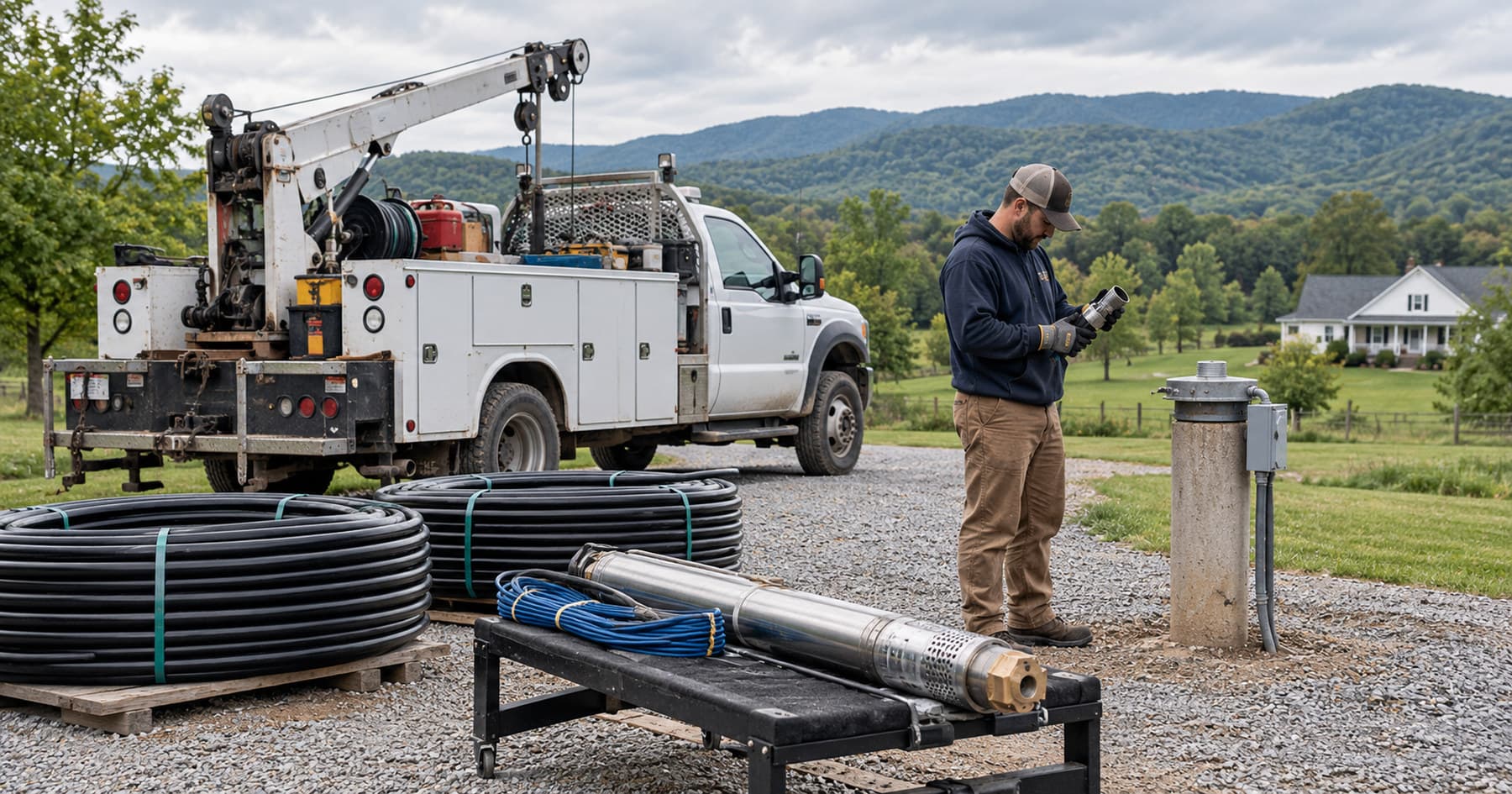
Submersible pump replacement is the most expensive common repair because the pump sits at the bottom of the well — often 100 to 400 feet down in Georgia's Piedmont and Blue Ridge provinces. Pulling the pump requires a crane or specialized well rig, which adds to the labor cost regardless of the pump's actual price.
Georgia Well Pump Replacement Cost: Full Breakdown
When a pump replacement is needed, the georgia well pump replacement cost includes the pump unit, labor to pull the old pump and install the new one, and any associated parts that should be replaced at the same time.
Pump unit: $300 to $1,200 depending on horsepower and depth rating. A 1/2 HP pump for a 150-foot well costs less than a 1 HP pump rated for 400 feet.
Drop pipe: The pipe connecting the pump to the surface. If it's corroded or damaged, replacement adds $200 to $800 depending on well depth.
Wiring: The electrical wire running from the control box to the pump. On deep wells, replacement wire costs $100 to $400.
Torque arrestor and safety rope: $50 to $150. These protect the pump and provide a safety recovery method.
Labor: Pulling and reinstalling a submersible pump takes 2 to 6 hours depending on well depth. Labor rates in Georgia run $75 to $150 per hour for licensed pump contractors.
Total all-in replacement cost for a typical Georgia well: $1,200 to $2,500 for a 200-foot Piedmont well, $1,500 to $3,500 for a 300+ foot Blue Ridge well, and $800 to $1,800 for a shallower Coastal Plain well.
Well Pump Service GA: Signs Your Pump Needs Repair
Catching pump problems early reduces the cost and prevents the complete loss of water to your home. Watch for these signs that your well pump needs well pump service GA professionals can diagnose.
Loss of water pressure. Gradually declining pressure over weeks or months often indicates a worn pump impeller, a failing pressure tank, or a dropping water table. Sudden pressure loss points to an electrical failure, pipe break, or pump seizure.
Short cycling. The pump turns on and off rapidly — every few seconds to minutes — instead of running for several minutes and then resting. This almost always means the pressure tank has failed (lost its air charge or has a ruptured bladder). A pressure tank replacement ($300 to $800) is far cheaper than the pump burnout that short cycling eventually causes.
No water at all. Complete water loss is the most urgent symptom. Check the breaker panel first — a tripped breaker is a free fix. If the breaker is fine, the problem is the pressure switch, control box, wiring, or the pump itself. Do not repeatedly reset a tripping breaker — the breaker is tripping for a reason (usually a shorted pump motor).
Sputtering or air in the water. Air coming from faucets indicates the pump is drawing air, which means the water level has dropped below the pump intake. This can happen during drought or if the well yield has decreased over time. The pump may need to be lowered or the well may need rehabilitation.
High electric bills. A struggling pump draws more electricity. If your bill spikes without other explanation, the pump motor may be failing and drawing excessive current before it burns out completely.
Well Pump Repair Price Georgia: Emergency vs. Scheduled
The well pump repair price georgia homeowners pay depends heavily on whether the repair is scheduled or emergency.
Emergency pump service (after-hours, weekends) typically costs 50% to 100% more than scheduled work. A $1,500 pump replacement becomes $2,200 to $3,000 as an emergency call. If you notice early warning signs — declining pressure, short cycling, or unusual noises — scheduling a repair during normal business hours saves significant money.
Most Georgia well pumps last 8 to 15 years depending on water quality, usage, and power stability. If your pump is approaching 10 years old and showing any symptoms, proactive replacement during a scheduled appointment is smarter than waiting for a midnight failure.
Find EPD-licensed well pump contractors through our Georgia well pump repair directory. For well water quality concerns, see our Georgia well water testing guide. Browse all Georgia septic and well water providers.
Frequently Asked Questions
How long do well pumps last in Georgia?
Submersible well pumps in Georgia typically last 8 to 15 years. Pumps in wells with sandy water, high iron, or acidic pH wear out faster. Pumps with lightning damage protection and proper pressure tank maintenance last longer. Jet pumps (used on shallower wells) last 5 to 10 years because their moving parts are exposed to more wear.
Can I replace my own well pump in Georgia?
Georgia requires EPD-certified pump contractors for well pump work. Even if you have the skills, the certification requirement exists because improper pump installation can contaminate the well, damage the casing, or create electrical hazards. Licensed contractors carry insurance and file the required reports with the county health department.
Does homeowners insurance cover well pump replacement?
Standard homeowners policies typically do not cover well pump failure from normal wear and age. Some policies cover pump damage from lightning strikes or power surges (both common in Georgia's thunderstorm-prone climate). Equipment breakdown coverage riders are available from some insurers for well pumps specifically. Check your policy and consider adding coverage if your pump is older than 10 years.
Should I replace the pressure tank when I replace the pump?
If your pressure tank is over 10 years old and you are replacing the pump, replacing the tank at the same time makes sense. The labor cost is minimal since the contractor is already on site, and an old pressure tank is the most common cause of premature pump failure due to short cycling. A new pressure tank costs $300 to $800 and protects your $1,500+ pump investment.
Find Georgia providers
Connect with local professionals in Georgia for your septic or well water needs.
Related reading
 cost-guide
Well Pump Repair Cost Virginia (2026)
Well pump repair cost virginia homeowners pay ranges $300–$2,000+. Full pricing by repair type, region, and pump depth.
 cost-guide
Well Pump Repair Cost South Carolina (2026)
Well pump repair cost south carolina ranges $200-$800 for repairs, $1,000-$3,000+ for replacement. SC pricing by pump type and depth.
 cost-guide
Well Pump Repair Cost NC: 2026 Pricing Guide
How much is well pump repair cost NC homeowners pay in 2026? Submersible pump repair, replacement, and emergency service call pricing.