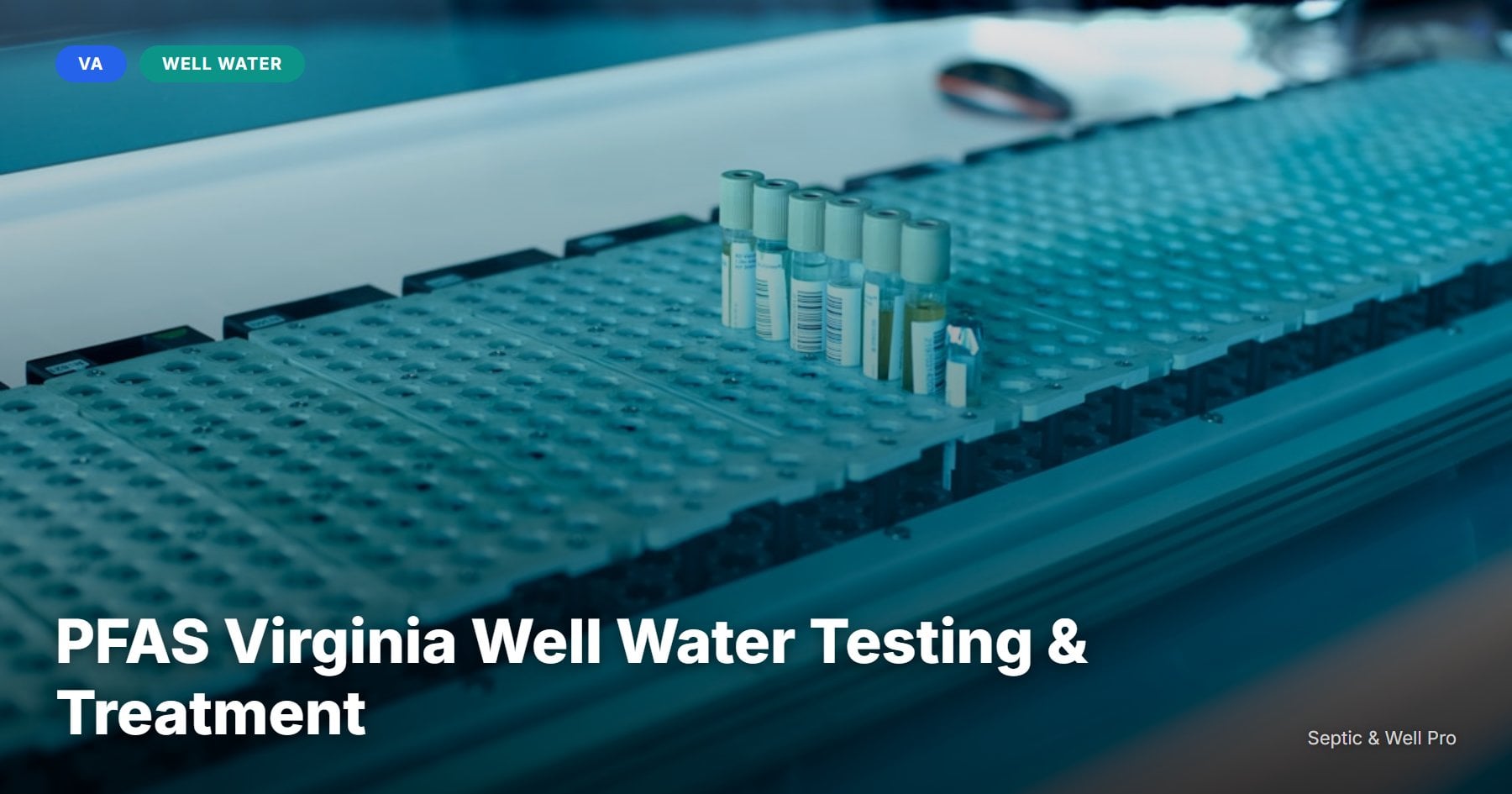
PFAS Virginia Well Water Testing & Treatment
PFAS virginia well water testing and treatment guide. EPA limits, military base contamination zones, and filter options for VA homeowners.
PFAS virginia well water contamination has become one of the most pressing water quality concerns for private well owners across the state. Per- and polyfluoroalkyl substances (PFAS) — often called "forever chemicals" because they do not break down in the environment — have been detected near military installations, airports, and industrial sites throughout Virginia. Unlike public water systems, private wells have no mandatory PFAS testing requirement, which means many Virginia homeowners may be drinking contaminated water without knowing it.
The EPA finalized enforceable Maximum Contaminant Levels (MCLs) for six PFAS compounds in April 2024, setting the limit for PFOA and PFOS at just 4 parts per trillion (ppt). That is an extraordinarily low threshold, reflecting how toxic these compounds are even at trace levels. While these federal standards apply directly to public water systems, they establish the benchmark that Virginia well owners should use when evaluating their own test results.
Where PFAS Contamination Threatens Virginia Well Water
PFAS virginia well water contamination is not evenly distributed. The highest-risk areas cluster around facilities that historically used aqueous film-forming foam (AFFF) for firefighting — primarily military bases and commercial airports. Virginia has several major contamination zones that private well owners should know about:
| Facility | Region | Status | Wells Affected |
|---|---|---|---|
| Naval Station Norfolk | Hampton Roads | Active investigation | Nearby private wells in Norfolk/Virginia Beach |
| Joint Base Langley-Eustis | Hampton Roads | Active investigation | Wells in Hampton, Newport News, York County |
| Marine Corps Base Quantico | Northern Virginia | Active investigation | Wells in Prince William, Stafford counties |
| Fort Barfoot (formerly Pickett) | Southside | Monitoring | Wells in Nottoway, Dinwiddie counties |
| Dulles International Airport | Northern Virginia | Monitoring | Wells in Loudoun County |
| Various fire training facilities | Statewide | Varies | Wells within 1–3 miles of foam use areas |
If your well is within three miles of any military base, airport, or known AFFF use site, PFAS testing Virginia wells in those areas should be a priority. The contamination plumes can extend significant distances through groundwater, especially in the Coastal Plain's sandy aquifers where water moves relatively quickly.
Beyond military sites, industrial sources also contribute to PFAS contamination. Manufacturing facilities that used PFAS-containing coatings, textiles treated with stain-resistant chemicals, and biosolids (treated sewage sludge) applied to agricultural land can all introduce PFAS into groundwater. Virginia's Piedmont and Shenandoah Valley agricultural areas where biosolid application has been common may have elevated PFAS levels in shallow wells.
PFAS Testing Virginia Wells: How to Get Tested
PFAS testing Virginia wells requires a specialized laboratory analysis — standard well water tests for bacteria and minerals do not detect PFAS compounds. Here is what you need to know about getting your well tested:
Choose an accredited lab. PFAS analysis requires EPA Method 533 or 537.1, performed by a laboratory accredited for these specific methods. Virginia's Division of Consolidated Laboratory Services (DCLS) can perform the analysis, and several private labs (Eurofins, SGS, TestAmerica) also offer accredited PFAS testing. Cost ranges from $200 to $500 per sample depending on how many PFAS compounds are included in the panel.
Proper sampling matters. PFAS are so pervasive that contamination of the sample itself is a real concern. Do not wear clothing treated with stain-resistant or waterproof coatings during sampling. Use only the bottles provided by the lab. Avoid contact with food wrappers, adhesive labels, or anything that might contain PFAS near the sample. Some labs offer sampling kits with detailed instructions; others recommend hiring a professional sampler.
What to test for. At minimum, test for the six PFAS compounds covered by the EPA MCLs: PFOA, PFOS, PFNA, PFHxS, HFPO-DA (GenX), and a mixture of these. A broader panel testing 20 to 40 PFAS compounds costs more but provides a fuller picture of contamination. Labs in Virginia typically offer both options.
For broader well water quality concerns beyond PFAS, our Virginia well water testing guide covers bacteria, minerals, and other common contaminants.
Understanding Your PFAS Test Results
PFAS results are reported in parts per trillion (ppt) or nanograms per liter (ng/L) — these units are equivalent. Use the EPA MCLs as your benchmark:
| PFAS Compound | EPA MCL | Health Concerns |
|---|---|---|
| PFOA | 4 ppt | Cancer, liver damage, thyroid disruption |
| PFOS | 4 ppt | Cancer, immune system effects, developmental harm |
| PFNA | 10 ppt | Liver, kidney, and immune effects |
| PFHxS | 10 ppt | Thyroid disease, cancer risk |
| HFPO-DA (GenX) | 10 ppt | Liver toxicity, kidney effects |
| Mixture of above | Hazard Index ≤ 1 | Cumulative health effects |
If any individual compound exceeds its MCL, or if the combined hazard index exceeds 1.0, treatment is strongly recommended. Remember: these limits are based on lifetime exposure risk, so even levels slightly above the MCL warrant action if this is your daily drinking water source.
PFAS Water Treatment Virginia: What Actually Works
Not all water treatment systems remove PFAS effectively. Virginia well owners need to choose from the three proven technologies:
Granular Activated Carbon (GAC). GAC filters adsorb PFAS onto carbon surfaces. They are effective for longer-chain PFAS (PFOA, PFOS) and moderately effective for shorter-chain compounds. Whole-house GAC systems cost $1,500 to $4,000 installed, with replacement carbon costing $300 to $800 annually. GAC is the most cost-effective option for moderate contamination levels.
Reverse Osmosis (RO). RO systems push water through a semi-permeable membrane that blocks PFAS molecules. Point-of-use RO systems (under-sink) cost $200 to $800 and remove 90% or more of all PFAS compounds. Whole-house RO systems cost $5,000 to $12,000. RO is the most effective single technology for PFAS removal but wastes 2 to 4 gallons of water for every gallon treated.
Ion Exchange (IX). Specialized PFAS-selective ion exchange resins are the newest and most targeted treatment option. They remove both long- and short-chain PFAS at very high efficiency. Whole-house IX systems cost $3,000 to $8,000, with resin replacement every 1 to 3 years ($500 to $1,500). IX is the best option for high contamination levels or when short-chain PFAS are present.
For moderate contamination near the EPA MCLs, a point-of-use RO system for drinking and cooking water combined with basic carbon filtration for the rest of the house is the most practical and affordable approach. For severe contamination well above the MCLs, a whole-house IX or GAC system with a polishing RO at the kitchen tap provides the most thorough protection.
Browse Virginia water treatment providers and PFAS water testing services in our directory to find qualified professionals near you.
Virginia State Resources for PFAS
Virginia's Department of Health and Department of Environmental Quality both track PFAS contamination:
The VDH PFAS page provides information about affected public water systems and links to sampling results. While this focuses on public water, it can help well owners understand contamination patterns in their area.
The DEQ PFAS page tracks environmental investigations at contaminated sites, including military bases. If your property is near a DEQ-listed PFAS site, you may qualify for free well testing through the site remediation program.
The EPA's PFAS testing rule for public water systems has produced extensive data that can indicate regional contamination patterns relevant to nearby private wells. Check whether your local public water utility has detected PFAS — if they have, private wells in the same aquifer likely have similar or higher levels since they lack treatment.
Frequently Asked Questions
How much does PFAS testing cost for a Virginia private well?
A basic PFAS panel testing the six EPA-regulated compounds costs $200 to $350. A comprehensive panel testing 20 to 40 compounds runs $350 to $500. Some Virginia health districts offer subsidized testing for wells near known contamination sites — contact your local VDH health district to ask about available programs.
Does a standard well water test check for PFAS?
No. Standard well water tests check for bacteria, nitrates, pH, and common minerals. PFAS require specialized laboratory methods (EPA 533 or 537.1) that are not included in routine testing. You must specifically request and pay for PFAS analysis.
Can boiling water remove PFAS?
No. Boiling actually concentrates PFAS by evaporating water while the chemicals remain behind. PFAS are extremely stable compounds that resist heat, chemical breakdown, and biological degradation — which is why they earned the "forever chemicals" label. Only physical removal through filtration (GAC, RO, or IX) works.
Should I test my well if I live far from a military base?
PFAS contamination is not limited to military sites. Industrial facilities, airports, fire stations, landfills, and agricultural land where biosolids were applied can all be sources. If your well is in a Coastal Plain sandy aquifer or downstream from any potential source, testing is a reasonable precaution. The $200 to $350 cost provides peace of mind and baseline data.
Does Virginia require private wells to be tested for PFAS?
No. Virginia does not require any specific testing for private wells. The EPA MCLs apply to public water systems, not private wells. Testing your private well for PFAS is entirely voluntary — but given the health risks and the prevalence of contamination sources in Virginia, proactive testing is strongly recommended.
Find PFAS Testing and Treatment in Virginia
PFAS virginia well water contamination is a growing concern that affects private well owners across the state, from the Hampton Roads military corridor to the agricultural valleys of the Piedmont. Testing is the only way to know whether your well is affected, and proven treatment options exist for every contamination level. Start by browsing our Virginia PFAS water testing directory to find accredited testing providers, and explore water treatment services if your results exceed EPA limits.
For a broader overview of Virginia well water quality, read our Virginia well water testing guide and well drilling cost guide for additional context.
Find Virginia providers
Connect with local professionals in Virginia for your septic or well water needs.
Related reading
 cost-guide
Well Pump Repair Cost Virginia (2026)
Well pump repair cost virginia homeowners pay ranges $300–$2,000+. Full pricing by repair type, region, and pump depth.
 city-guide
Best Septic Companies Suffolk VA (2026)
Best septic companies Suffolk VA homeowners rely on for pumping, CBPA compliance, inspections, and rural system repair.
 buyers-guide
Buying Home Septic System Virginia: HB 2671 Guide
Buying home septic system virginia? HB 2671 requires inspections. What buyers must check, costs, and red flags to watch.