
Septic Tank Size Pennsylvania: Complete Guide
The right septic tank size Pennsylvania regulations require depends on bedrooms and water use. Use our sizing guide to meet PA requirements.
Choosing the right septic tank size Pennsylvania regulations require isn't optional — it's strictly enforced. Your Sewage Enforcement Officer (SEO) must approve the tank capacity as part of the permit process. Undersized tanks lead to frequent pumping, drain field overload, and premature failure.
Pennsylvania sizes septic systems by the number of bedrooms, not by bathrooms or current occupants. This approach accounts for potential future use. Bedrooms determine how many people could live in the house, so septic tank size Pennsylvania code ties directly to that number.
Septic Tank Size Pennsylvania: Minimum Requirements
PA DEP regulations under Act 537 set minimum tank capacities based on estimated daily sewage flow. For residential properties, this translates to a bedroom-based sizing chart that your SEO and installer follow.
| Number of Bedrooms | Minimum Tank Size (Gallons) | Estimated Daily Flow (GPD) |
|---|---|---|
| 1–3 | 900 | Up to 400 |
| 4 | 1,250 | Up to 500 |
| 5 | 1,500 | Up to 600 |
| 6 | 1,750 | Up to 700 |
| Each additional bedroom | Add 250 gallons | Add 100 GPD |
These are minimums. Many PA installers and SEOs recommend going one size up for better performance and longevity. A 1,000-gallon tank for a 3-bedroom home costs roughly the same as a 900-gallon tank but provides a valuable buffer.
PA Septic Tank Capacity: Factors Beyond Bedrooms
While bedrooms set the baseline, several factors should push you toward a larger PA septic tank capacity than the minimum.
Water Usage Habits
A family of four that runs two loads of laundry daily, takes long showers, and uses a dishwasher twice a day puts more volume through the system than the sizing chart assumes. If your household uses water heavily, going up one tank size prevents overloading.
Garbage Disposals
Kitchen garbage disposals add significant solid waste to the tank. PA regulations account for this by increasing the required tank size by 50% when a garbage disposal is installed. A 3-bedroom home with a disposal needs a 1,350-gallon tank instead of 900. Many installers recommend skipping the disposal entirely — it's easier and cheaper than upsizing the tank and pumping more often.
Home-Based Businesses
If you run a business from home that generates wastewater — a salon, daycare, or rental unit — your SEO may calculate the flow differently. Commercial flows follow separate PA DEP guidelines and often require larger tanks and drain fields.
Hot Tubs and Extra Fixtures
A hot tub drained into the septic system adds several hundred gallons at once. Multiple laundry machines, extra bathrooms beyond what's typical for the bedroom count, or a finished basement with a full bath all increase actual flow beyond the standard estimate.
Septic Tank Sizing Guide: Choosing the Right Tank
This septic tank sizing guide helps you think beyond the minimum PA requirement and select a tank that performs well over its full lifespan.
Rule of thumb: Your tank should hold at least two days of peak wastewater flow. For a typical 3-bedroom PA home producing 400 gallons per day, that means 800+ gallons of working capacity. Since some tank volume is taken up by sludge and scum layers between pumpings, a 1,000-gallon tank gives you adequate working capacity.
Two-compartment tanks. PA regulations allow and many SEOs prefer two-compartment tanks. The first compartment (about two-thirds of the total volume) handles primary settling. The second provides additional treatment before effluent reaches the drain field.
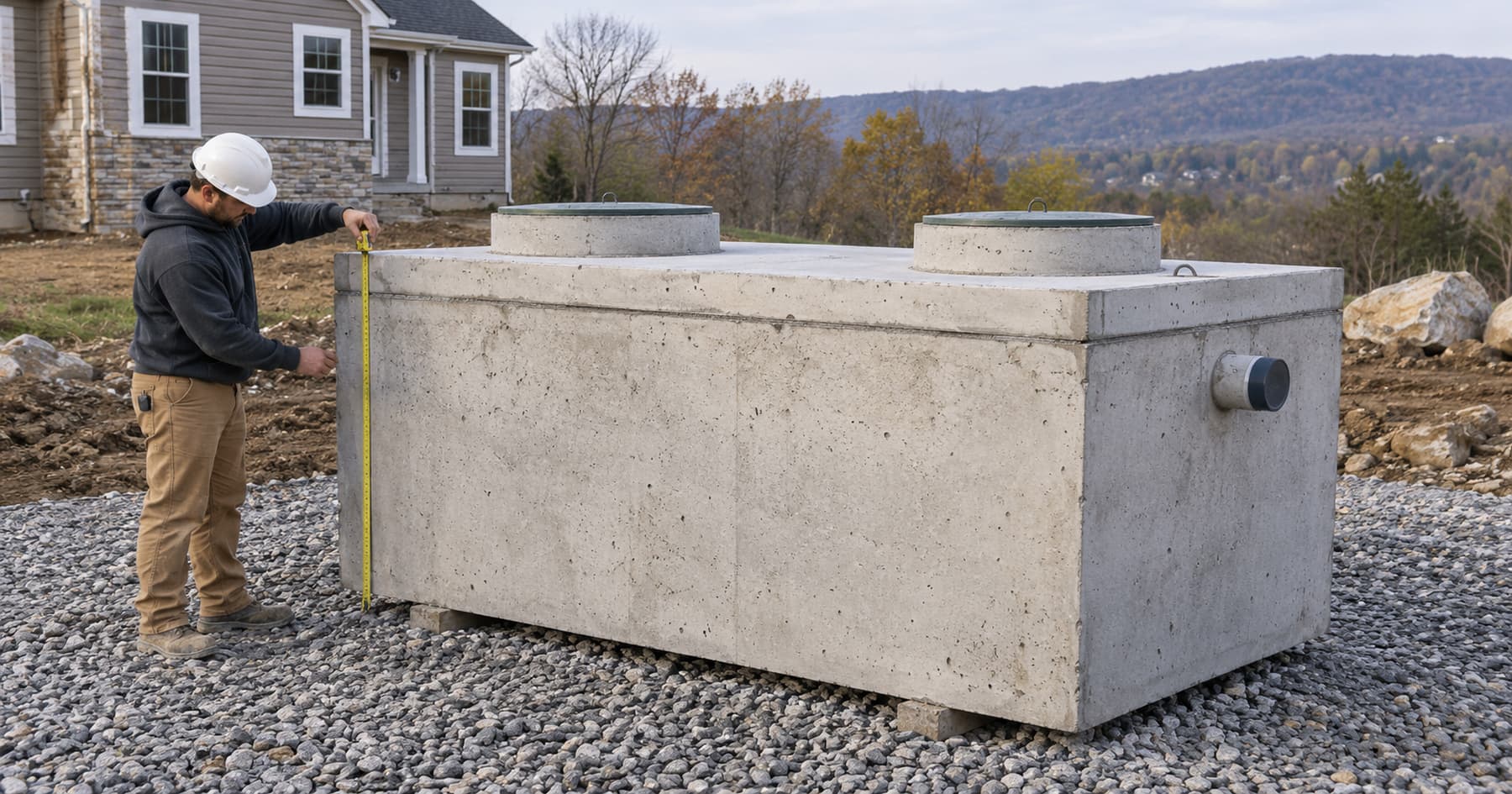
Material choices. Concrete tanks dominate the PA market. They're durable (40+ years), heavy enough to resist buoyancy in high water table areas, and readily available statewide.
Plastic (polyethylene) tanks cost less and are lighter, making them easier to install on steep or remote sites. Fiberglass tanks offer corrosion resistance but cost more. Your installer will recommend based on site conditions.
How Big Septic Tank PA: Common Scenarios
Here's how big a septic tank PA homeowners actually need in common situations.
Scenario 1: New 3-bedroom home, standard water use, no disposal. Minimum: 900 gallons. Recommended: 1,000 gallons. Cost difference: roughly $100 to $200 for the larger tank.
Scenario 2: 4-bedroom home with garbage disposal. Minimum with disposal: 1,875 gallons (1,250 x 1.5). Most installers round up to a 2,000-gallon tank. Consider eliminating the disposal to use a standard 1,250-gallon tank instead.
Scenario 3: 3-bedroom cabin used seasonally. Minimum: 900 gallons. A seasonal home might seem like a candidate for a smaller tank, but PA regulations don't reduce requirements for part-time use. The system must handle full occupancy regardless of how often you're there.
Scenario 4: 5-bedroom home with in-law suite. Minimum: 1,500 gallons. If the in-law suite has its own kitchen and laundry, your SEO may classify it as a separate dwelling unit requiring additional capacity. Discuss this with your SEO early in the permit process.
Signs Your PA Septic Tank Is Undersized
If your existing tank is too small for your household's water use, you'll notice these symptoms:
- Frequent pump-outs needed (more than every 2 years for a family of four)
- Slow drains or frequent minor backups after heavy water use days
- Sludge layer exceeds one-third of tank volume at each pumping
- Scum layer thickens quickly between pumpings
- Effluent filter clogs frequently (if your system has one)
An undersized tank sends partially treated wastewater to the drain field too quickly. Over time, this clogs the absorption area and shortens the drain field's lifespan. If you're seeing these symptoms, consult a PA septic professional about upgrading.
Upgrading an Undersized Tank in PA
Replacing a too-small tank requires a permit from your SEO but is less disruptive than a full system replacement. The process involves pumping and removing the old tank, excavating for the new larger tank, installing the new tank and reconnecting piping, and SEO inspection before backfill.
Cost ranges from $3,000 to $7,000 depending on tank size, material, excavation difficulty, and whether any piping modifications are needed. It's significantly cheaper than replacing a drain field that failed prematurely because an undersized tank overwhelmed it.
Some homeowners add a second tank in series rather than replacing the existing one. This effectively doubles capacity without removing the original tank. Your SEO must approve this approach, but it can be cost-effective when the existing tank is in good condition. Search our PA directory for contractors experienced with tank upgrades.
Frequently Asked Questions About Septic Tank Size in Pennsylvania
Can I install a smaller tank if only two people live in my 4-bedroom home?
No. PA sizes tanks by bedroom count, not occupant count. Your 4-bedroom home requires a minimum 1,250-gallon tank regardless of how many people currently live there. This protects future buyers and accounts for the home's capacity.
Does adding a bedroom require a larger septic tank?
If adding a bedroom pushes you past a sizing threshold (like going from 3 to 4 bedrooms), yes. You'll need to upgrade the tank and possibly the drain field. This requires an SEO permit. Some municipalities won't approve bedroom additions without proof of adequate septic capacity.
How often should different tank sizes be pumped?
Pumping frequency depends on tank size and household size. A 1,000-gallon tank serving two people can go 5 or more years between pumpings. The same tank serving a family of five may need pumping every 2 to 3 years. Your pumping contractor can measure sludge and scum levels to determine the optimal schedule for your situation.
Are two smaller tanks better than one large tank?
Two tanks in series actually provide better treatment than a single tank of equivalent total volume. The first tank handles primary settling while the second polishes the effluent. However, two tanks cost more to install and maintain than one. Discuss the tradeoffs with your installer and SEO during the design phase.
Find Pennsylvania providers
Connect with local professionals in Pennsylvania for your septic or well water needs.
Related reading
 city-guide
Well Drilling Cost Pennsylvania: 2026 Price Guide
The well drilling cost Pennsylvania homeowners pay ranges from $5,000 to $15,000+. Get 2026 prices by region, depth, and geology in this detailed guide.
 state-guide
Septic Companies Lancaster PA — Local Experts (2026)
Trusted septic companies Lancaster PA homeowners rely on for pumping, inspections, and repairs. Get the full Lancaster County septic guide for 2026.
 state-guide
Septic Companies Allentown PA — Lehigh Valley (2026)
Top septic companies Allentown PA and the Lehigh Valley area. Find pumping, inspection, and repair services across Lehigh and Northampton counties.