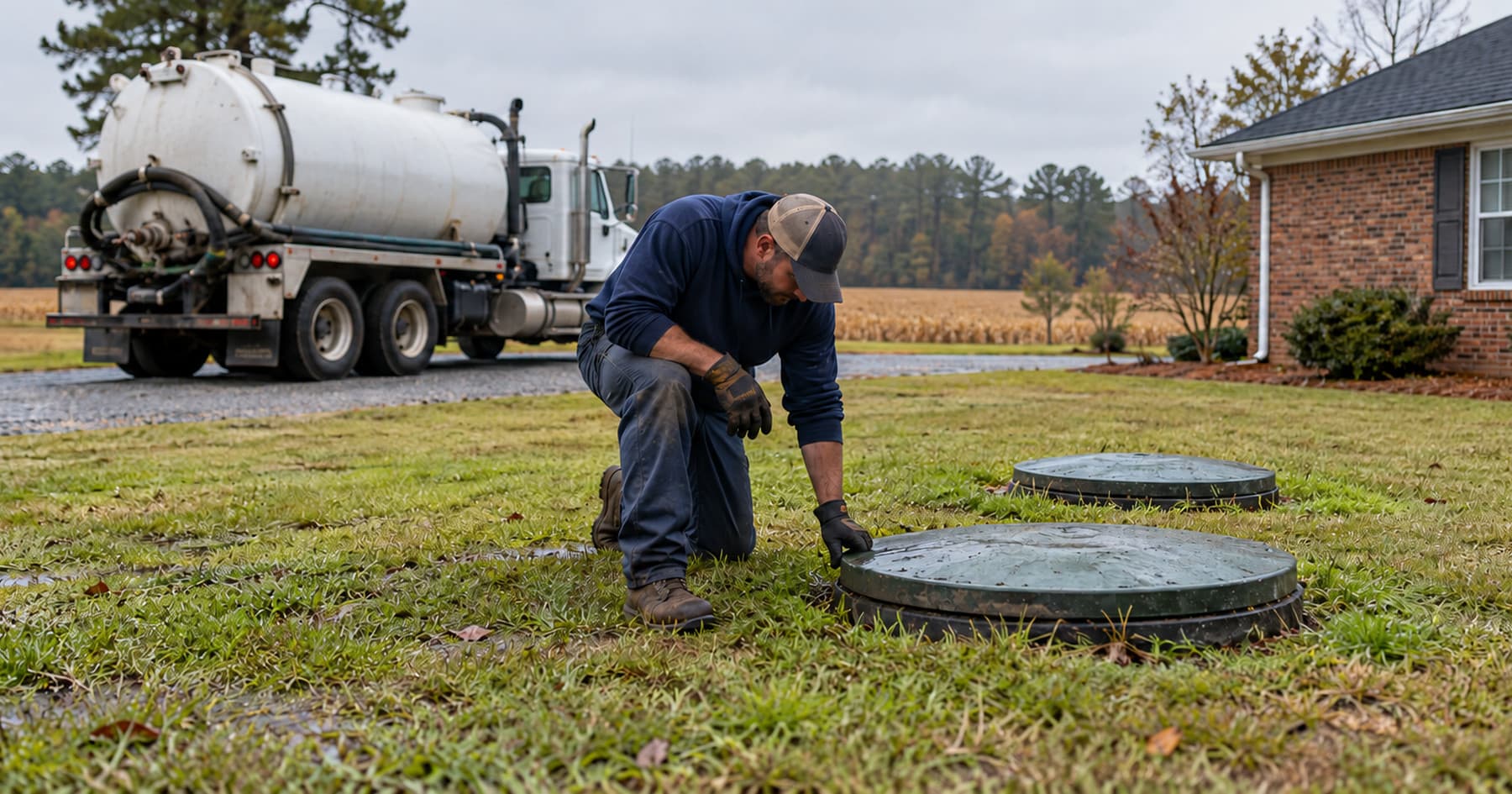
Septic Services Goldsboro NC: Wayne County Guide
Find septic services Goldsboro NC homeowners trust. Covers Wayne County coastal plain conditions, Goldsboro NC septic pumping costs, and local contractors.
Goldsboro sits in the heart of Wayne County in eastern North Carolina, with a population around 36,000. The city is home to Seymour Johnson Air Force Base and serves as a regional hub for surrounding agricultural communities. Like most eastern NC cities, Goldsboro's municipal sewer covers the urban core but leaves surrounding Wayne County dependent on private septic systems and wells. The flat coastal plain terrain, sandy loam soils, and history of significant flooding events shape how homeowners here approach wastewater treatment and water supply.
Wayne County is one of North Carolina's leading agricultural counties, producing tobacco, sweet potatoes, cotton, and hogs. This agricultural activity affects both soil conditions and groundwater quality in ways that directly impact septic and well systems. If you live outside Goldsboro's sewer boundary or you're buying rural property in Wayne County, understanding septic services Goldsboro NC providers deliver gives you a practical advantage. Quality septic services Goldsboro NC homeowners rely on address the unique coastal plain challenges.
Coastal Plain Conditions in Wayne County
Wayne County lies entirely in the coastal plain, where soils consist primarily of sandy loam, loamy sand, and clay-loam mixtures. The terrain is flat — elevation changes of more than a few feet are noteworthy. This flat landscape means surface water drains slowly, and the water table sits relatively close to the surface throughout much of the county.
Most Wayne County properties can support conventional gravity-fed septic systems. The sandy component of the soil provides adequate drainage for standard drain fields on many lots. However, lower-lying areas near the Neuse River, Little River, and Stoney Creek often have seasonal high water tables that require modified system designs. Mound systems and low-pressure pipe designs address these conditions by providing additional separation between the drain field and groundwater.
Goldsboro well water draws from Wayne County's coastal plain sedimentary aquifers. These wells typically produce good yields from moderate depths. Water quality varies — iron and manganese are common aesthetic issues. The bigger concern is agricultural contamination. With the intensity of farming in Wayne County, nitrate levels in shallow wells near active cropland deserve careful monitoring through regular well water testing.
Septic Services Available in Goldsboro NC
Goldsboro NC septic pumping is the most basic and important service for Wayne County homeowners. Pumping every 3 to 5 years keeps your system functioning properly. In areas with higher water tables, more frequent pumping provides extra protection by reducing the effluent load on drain fields that may already be working at capacity during wet seasons.
Septic inspections serve routine maintenance needs and real estate transactions. Wayne County's older housing stock includes many systems installed 30 or more years ago. These aging systems may have concrete tanks showing deterioration, undersized drain fields by current standards, or outdated designs that don't meet modern code. A thorough inspection reveals the true condition and helps plan any needed repairs or upgrades.
New installations support both new construction and system replacements. Coastal plain soils are generally cooperative for installation work — excavation is straightforward in sandy loam, and conventional designs work on many properties. Sites with water table challenges need engineered solutions that cost more but perform reliably. The Wayne County permitting process determines what your specific lot requires.
Well services encompass drilling, pump maintenance, water testing, and filtration. Given Wayne County's agricultural intensity, well owners should consider comprehensive water testing that goes beyond the standard coliform and nitrate screen. Pesticide and herbicide testing adds valuable information for wells near active farmland.
Check the Goldsboro area provider directory to find local contractors.
Cost Expectations in Wayne County
Eastern NC costs run lower than the Triangle, Charlotte, or coastal resort areas. Wayne County's relatively straightforward soil conditions and moderate labor rates keep septic services affordable. Here's what homeowners can expect to pay:
| Service | Average Cost | Typical Range |
|---|---|---|
| Septic Pumping | $300 | $225–$400 |
| Septic Inspection | $300 | $200–$400 |
| Well Water Test (basic) | $115 | $50–$175 |
| New Septic Installation | $9,500 | $5,500–$15,000 |
| Drain Field Repair | $3,500 | $1,500–$6,500 |
Standard gravity systems on well-drained lots represent the lower end. Properties requiring mound systems or advanced treatment due to high water tables approach the upper range. Military families stationed at Seymour Johnson should note that VA loans may require septic inspections, so factor that cost into your home-buying budget.
Wayne County Permitting
Wayne County Environmental Health handles on-site wastewater permitting. The process follows North Carolina's statewide framework: a soil evaluation determines your site's characteristics, and the county issues an Improvement Permit specifying the system design, tank size, and drain field requirements.
Wayne County's coastal plain soils generally classify favorably for conventional systems, which streamlines the permitting process for many properties. Sites near waterways or in low-lying areas face additional scrutiny and may require enhanced designs. The county processes permits within 2 to 6 weeks depending on season and workload.
If you're buying property near the base, the county coordinates with military installation environmental offices for properties that may be affected by base-related groundwater conditions. Seymour Johnson Air Force Base has ongoing environmental monitoring programs that can provide useful information about surrounding groundwater quality.
Flooding: Goldsboro's Recurring Challenge
Wayne County has experienced devastating floods multiple times — Hurricane Floyd in 1999, Hurricane Matthew in 2016, and Hurricane Florence in 2018 all caused major damage in the Goldsboro area. The Neuse River and its tributaries overflow during extreme rainfall, inundating homes and infrastructure including septic systems.
Floodwater infiltrating a septic tank dilutes and disrupts the bacterial colonies that break down waste. Sediment clogs distribution lines and drain field media. Electrical components like pumps and alarms fail after submersion. Recovery ranges from a simple pump-out to complete system replacement depending on flood severity and duration.
If your property sits in a FEMA flood zone, consider flood-resilient system features during any new installation or major repair. Sealed tanks with anti-flotation anchors, waterproof electrical connections, and elevated control panels all reduce post-flood damage. These upgrades add upfront cost but save significantly during recovery. After any flooding event, have a professional conduct a full septic inspection before resuming normal use.
Agricultural Impact on Well Water
Wayne County's agricultural economy directly affects groundwater quality for well owners. Commercial farming operations apply fertilizers, pesticides, and herbicides across thousands of acres. In the sandy coastal plain soils, these chemicals can percolate to groundwater relatively quickly compared to clay regions.
Nitrate contamination is the primary concern. The EPA drinking water standard is 10 mg/L, and shallow wells near heavily fertilized fields can approach or exceed this level. Infants are particularly vulnerable to nitrate contamination, which can cause blue baby syndrome. If your household includes infants, test more frequently and consider treatment if levels approach 5 mg/L.
Hog farming operations in Wayne County add another dimension. Animal waste lagoons, when properly managed, shouldn't affect nearby wells. But failures or overflow events can contaminate groundwater with bacteria, nitrates, and other pollutants. Know your proximity to animal operations and test your well accordingly. A comprehensive test panel that includes bacteria, nitrates, pesticides, and basic chemistry provides the most complete picture of your water quality.
Military Community Considerations
Seymour Johnson Air Force Base brings thousands of military families to the Goldsboro area. Many service members buy or rent homes outside the base in areas served by septic systems. If you're PCSing to Seymour Johnson, here are a few things to know:
VA loans typically require a satisfactory septic inspection as part of the home-buying process. Budget $200 to $400 for this. If the inspection reveals problems, the seller usually addresses repairs before closing. Don't skip or rush this step — a thorough inspection protects your investment.
If you're renting a home with a septic system, make sure the lease clarifies maintenance responsibilities. Pumping, which is a recurring expense, should be the landlord's responsibility. Report slow drains, odors, or standing water in the yard promptly — early intervention prevents expensive damage.
Military families who PCS every 2 to 3 years face a specific challenge: they buy homes, maintain them for a short tour, then sell. Getting a septic inspection when you arrive and maintaining pumping records throughout your tour creates documentation that smooths the selling process when orders come. Buyers trust homes with documented maintenance history, and a clean septic inspection report can accelerate a sale. Given the military community's frequency of moves, Goldsboro-area providers are accustomed to working with service members on this cycle.
Aging Systems in Wayne County
Much of Wayne County's housing stock was built during the 1960s through 1980s, and the septic systems installed during that era are reaching or exceeding their expected lifespan. Concrete tanks from this period may show cracking, root intrusion through joints, or baffle deterioration. Original drain fields designed for smaller water usage patterns may struggle with modern dishwashers, washing machines, and multiple-bathroom homes.
If you own a home with a system that's 30 or more years old, consider a proactive professional evaluation rather than waiting for failure. A contractor can assess the tank's structural condition, measure sludge and scum layers, and evaluate drain field performance. The cost of this evaluation — typically $300 to $500 including a pump-out — is a small investment compared to the $8,000 to $15,000 cost of emergency replacement when a system fails without warning.
Surrounding Service Areas
Septic companies based in Goldsboro serve communities throughout Wayne County and adjacent areas. Pikeville and Fremont sit to the north and east with rural properties on aging systems. Mount Olive lies south in the county's agricultural heartland. Seven Springs, Dudley, and Eureka round out the Wayne County territory. Some providers extend into Johnston, Lenoir, and Greene counties.
Eastern NC's lower population density means fewer providers serve the market, but those operating here have deep experience with coastal plain conditions. Most reach any Wayne County location within 25 minutes. Confirm service area coverage and any travel charges when requesting quotes.
Frequently Asked Questions
How does living near Seymour Johnson AFB affect my well water?
Military bases sometimes have historical contamination from fuels, solvents, and other chemicals used in operations. Seymour Johnson has environmental monitoring programs, and the base coordinates with local agencies on groundwater issues. If your property borders the base, test your well for volatile organic compounds (VOCs) in addition to standard parameters. The base environmental office can provide information about any known contamination plumes.
Is my Wayne County home in a flood zone?
Check FEMA flood maps at fema.gov/flood-maps. Properties near the Neuse River, Little River, and Stoney Creek are most likely in mapped flood zones. But Wayne County's flat terrain means flooding can extend beyond mapped zones during extreme events like hurricanes. Even if you're technically outside the flood zone, proximity to waterways warrants flood awareness for your septic system.
How do I protect my septic system from agricultural contamination?
Your septic system sends effluent into the ground, not the other way around — agricultural contamination is primarily a well water concern, not a septic issue. Protect your well by testing annually, maintaining proper well construction with an intact casing seal, and ensuring adequate distance between your well and any agricultural activity. Report suspected contamination to Wayne County Environmental Health.
Can I pump my own septic tank?
No. North Carolina requires licensed haulers to pump and transport septic waste. The waste must be properly disposed of at an approved facility. Licensed haulers carry insurance, use proper equipment, and follow state regulations for handling and disposal. The cost of professional pumping — $225 to $400 in the Goldsboro area — is money well spent for proper, legal service.
Find Septic Services in Goldsboro, NC
Wayne County's conditions demand septic services Goldsboro NC contractors who understand coastal plain soils, agriculture, and flood risks. Whether you need routine septic pumping, a VA-required inspection, or a flood-resilient installation, qualified local providers serve the Goldsboro area. Browse our Goldsboro septic and well directory to compare companies and connect with contractors who understand eastern NC's specific challenges.
Find North Carolina providers
Connect with local professionals in North Carolina for your septic or well water needs.
Related reading
 city-guide
Hilton Head Septic Services & Beaufort SC Guide
Hilton head septic services face unique coastal challenges from tidal influence and saltwater intrusion. Beaufort County permits and costs.
 city-guide
Best Septic Companies Christiansburg VA (2026)
Top septic companies Christiansburg VA homeowners trust for pumping, inspections, and repair. Montgomery County tips and pricing.
 city-guide
Best Septic Companies Mechanicsville VA (2026)
Find the best septic companies Mechanicsville VA has for pumping, inspections, and drain field repair. Hanover County tips and pricing.