
Signs Your Septic System Is Failing in South Carolina
Recognize septic system failure signs south carolina homeowners commonly face — from sewage odors and soggy yards to well contamination and slow drains.
Knowing the septic system failure signs south carolina homeowners should watch for can save you thousands of dollars in emergency repairs. South Carolina has approximately 770,000 septic systems, and many are aging, undersized for current household demands, or stressed by the state's unique environmental conditions. From the dense red clay of the Upstate to the tidal influence of the Lowcountry, South Carolina's geography creates region-specific failure patterns that every homeowner should understand.
A failing septic system does not break overnight. It sends warning signals weeks or months before a catastrophic backup or drain field collapse. Catching these signs early and calling an SCDES-licensed contractor (formerly DHEC-licensed) can mean the difference between a $300 pump-out and a $15,000 drain field replacement. Here are the warning signs to watch for and what they mean in the context of South Carolina's specific conditions.
Warning Sign 1: Sewage Odors Near the Tank or Drain Field
If you smell rotten eggs, sulfur, or raw sewage near your septic tank, drain field, or inside your home, the system is not properly containing and treating waste. Odors are one of the earliest septic system failure signs south carolina homeowners notice, and they should never be ignored.
In the Lowcountry and Grand Strand, odors can be more pronounced during summer months when high temperatures accelerate decomposition and high water tables reduce the soil's ability to filter gases. Tidal influence in Charleston, Beaufort, and Georgetown counties can push groundwater up against the drain field, forcing gases to the surface rather than allowing them to dissipate through the soil column.
What to do: Schedule a septic inspection with an SCDES-licensed contractor. Do not pour bleach, chemical treatments, or deodorizers into the system — these can kill the beneficial bacteria that break down waste and make the problem worse.
Warning Sign 2: Slow Drains Throughout the House
A single slow drain usually indicates a localized clog in that fixture's pipe. But when multiple drains — sinks, showers, tubs, and toilets — are all draining slowly at the same time, the problem is downstream in the septic system. The tank may be full of solids, the outlet pipe may be blocked, or the drain field may be saturated and unable to accept effluent.
Slow drains are among the most common septic problems south carolina homeowners report, particularly in older homes with undersized 500- or 750-gallon tanks that were standard decades ago. If your home has been expanded or the household size has increased since the system was installed, the existing system may simply be overwhelmed.
Warning Sign 3: Soggy Ground Over the Drain Field
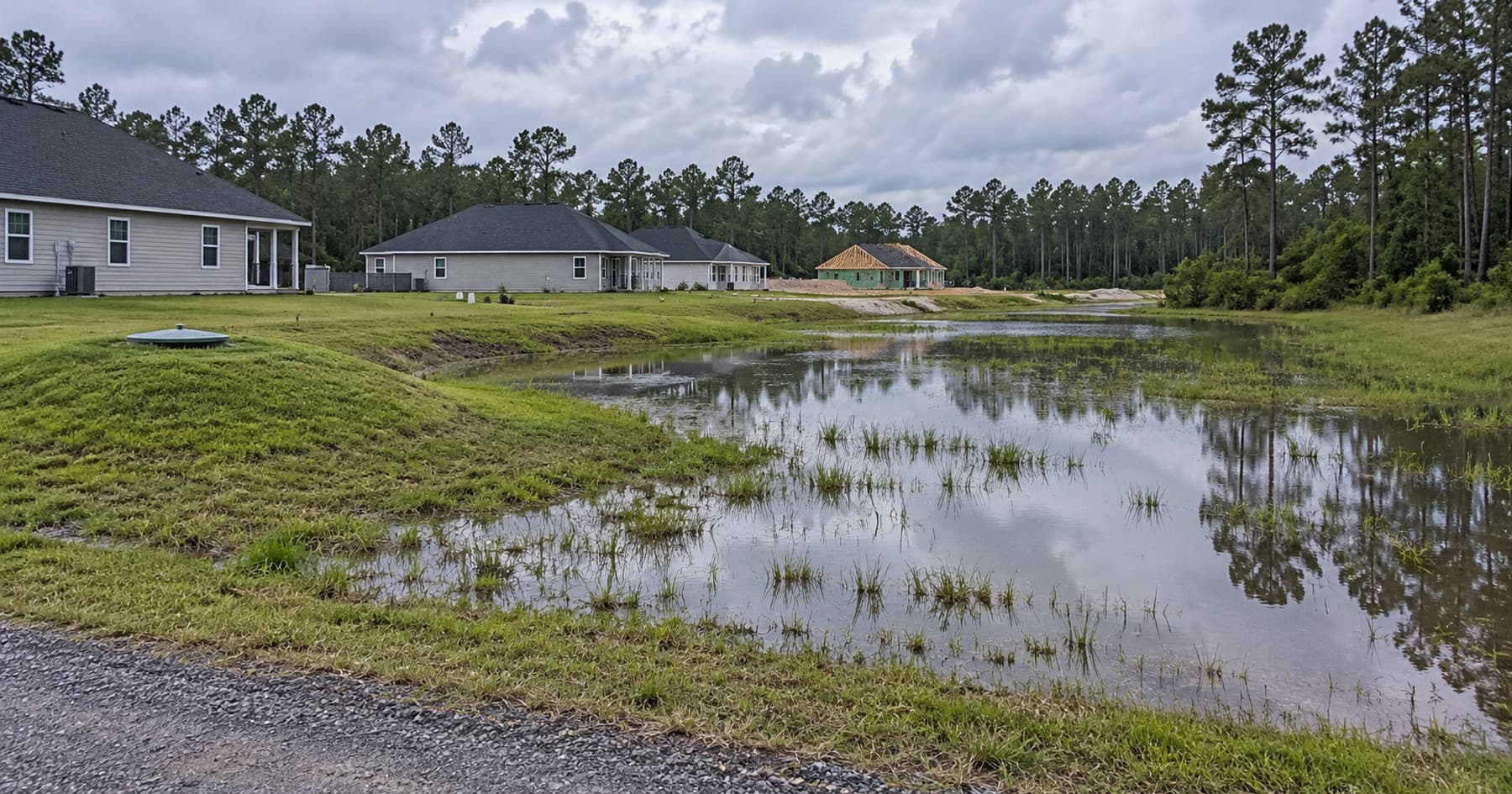
Wet, spongy, or soggy soil over your drain field — especially during dry weather — indicates that the absorption trenches are saturated and effluent is rising to the surface rather than percolating down through the soil. This is a serious failing septic system SC indicator that requires immediate professional evaluation.
In the Lowcountry, distinguishing between a failing drain field and seasonal high water table conditions can be challenging. The Lowcountry's water table can rise within 12 to 24 inches of the surface during rainy periods, creating conditions that mimic drain field failure even in properly functioning systems. An SCDES-licensed contractor can determine whether the soggy ground is a system failure or a seasonal groundwater issue.
In the Upstate, the dense red clay soils of the Piedmont region compact over time, reducing the soil's ability to absorb effluent. A drain field that worked well when installed may gradually lose capacity as the surrounding clay compresses and fills the spaces between soil particles that once allowed water to flow through.
Warning Sign 4: Unusually Lush or Green Grass Over the Drain Field
Your drain field area should look similar to the rest of your lawn. If the grass directly above the drain field is noticeably greener, thicker, or taller than surrounding vegetation — especially during dry spells when the rest of the lawn is stressed — it means nutrient-rich effluent is reaching the surface and fertilizing the grass. This is the soil telling you it cannot handle the wastewater load.
This sign is particularly visible in the Midlands and Pee Dee regions during South Carolina's hot, dry summers. When surrounding grass turns brown from drought stress but the drain field strip stays emerald green, the system is effectively irrigating the surface with partially treated wastewater.
Warning Sign 5: Sewage Backups in the Home
Raw sewage backing up through toilets, floor drains, or bathtub drains is the most obvious and urgent septic tank failure sign. By the time waste is backing up into your home, the system has been struggling for some time. The tank is either critically full, the outlet is completely blocked, or the drain field has failed and can no longer accept any effluent.
Do not attempt to plunge or snake a septic-related backup yourself. Stop using water in the home immediately to prevent additional waste from entering the system. Call an SCDES-licensed pumping company for emergency service. While emergency pumping costs 50 to 100 percent more than scheduled service, it prevents sewage from further contaminating your home.
Warning Sign 6: Gurgling Sounds in Plumbing
Persistent gurgling, bubbling, or glug-glug sounds from drains and toilets — especially when you run water elsewhere in the house — indicate that the septic system is struggling to accept wastewater. Air being displaced by water in a restricted system creates these sounds. Gurgling combined with slow drains is a strong indicator of an approaching failure.
Gurgling that only occurs in a single fixture is more likely a venting issue in your plumbing system rather than a septic problem. But when gurgling appears in multiple fixtures simultaneously, the septic system should be evaluated promptly before conditions worsen.
Warning Sign 7: Well Water Contamination
If your well water suddenly tests positive for coliform bacteria, nitrates, or has an unusual taste or odor, a failing septic system may be contaminating your groundwater. This is one of the most dangerous septic problems south carolina homeowners can face because it directly threatens your drinking water supply.
South Carolina requires a minimum 50-foot setback between septic tanks and wells, and 100 feet from drain fields to wells. But these distances assume a properly functioning system. A failing drain field can send untreated effluent through the soil beyond the normal treatment zone, potentially reaching your well. Properties where the well is downhill or downslope from the drain field face the highest risk.
If you detect contamination in your well water, stop using it for drinking and cooking immediately. Have both the well and septic system evaluated by separate licensed professionals. The contamination source needs to be confirmed — it may be the septic system, but agricultural runoff, surface water intrusion, or a damaged well casing can produce similar results.
Warning Sign 8: Standing Water or Surfacing Effluent
Visible standing water or grayish liquid pooling on the ground surface near the septic tank or drain field is a clear sign of system failure. This effluent contains bacteria, viruses, and nutrients that pose health risks to people, pets, and the environment. Standing effluent also attracts insects and creates odor complaints from neighbors.
In the Lowcountry, standing water can be confused with tidal flooding or high water table conditions, but septic effluent has a distinctive gray color and sewage odor that distinguishes it from clean groundwater. In coastal areas of Charleston, Beaufort, and Horry counties, sea-level rise of approximately 10 inches since 1950 has raised baseline water tables, pushing some drain fields closer to saturation even under normal conditions.
SC-Specific Septic Failure Causes
South Carolina's diverse geography creates region-specific failure patterns that go beyond the universal causes of neglect and overuse. Understanding these regional factors helps you anticipate problems before they become emergencies.
Upstate: Red Clay Soil Compaction
The Upstate's Piedmont clay soils are the most challenging for septic systems in South Carolina. Red clay compacts over time, reducing percolation rates and slowly strangling the drain field's ability to absorb effluent. Heavy equipment driving over the drain field — even once — can compact the soil enough to cause permanent damage. Systems installed in Greenville, Spartanburg, Anderson, and Cherokee counties require vigilant protection of the drain field surface.
Prevention: Never drive vehicles, park equipment, or place heavy structures over the drain field. Avoid planting trees with aggressive root systems (willows, maples, poplars) within 30 feet of the absorption area. Direct surface water drainage away from the drain field to prevent waterlogging the clay.
Lowcountry: High Water Tables and Tidal Influence
The Lowcountry's low elevation, high water tables, and tidal influence create uniquely challenging conditions for septic systems. During king tides and heavy rain events, groundwater can rise to within inches of the drain field, eliminating the unsaturated soil zone that treats effluent before it reaches groundwater. Charleston, Beaufort, Berkeley, and Dorchester counties face these conditions regularly.
Sea-level rise compounds the problem. The approximately 10 inches of rise along South Carolina's coast since 1950 has permanently raised baseline water tables in many low-lying areas. Systems installed decades ago with adequate groundwater separation may now operate with marginal clearance, leading to premature drain field saturation and failure.
Coastal Growth Corridors: Aging Systems in Rapidly Developing Areas
Horry County (Myrtle Beach and the Grand Strand) and the Charleston metro are among the fastest-growing areas in the United States. Many homes in these corridors have septic systems that were installed when the surrounding area was rural. As development increases impervious surfaces, alters drainage patterns, and raises water usage, these aging systems face stresses they were never designed to handle.
Properties in Horry, Charleston, and Beaufort counties with septic systems installed before 2000 should be evaluated by an SCDES-licensed professional to confirm the system can still handle current conditions. Population density, lot development, and water table changes may have outpaced the original system design.
Septic System Failure Signs in South Carolina: What to Do
Taking the right action when you notice septic system failure signs south carolina conditions can cause saves money and prevents environmental contamination.
- Reduce water usage immediately. Stop doing laundry, limit showers, and avoid running dishwashers. Every gallon you put into the system makes the problem worse while the drain field is compromised.
- Call an SCDES-licensed contractor. Only SCDES-licensed professionals (formerly DHEC-licensed) should evaluate and repair septic systems. Ask for both a pumping company and a system inspector — they are often different contractors.
- Do not pump the drain field. This is a common mistake. Pumping removes water from the tank, not from the saturated drain field. The drain field needs professional evaluation to determine whether repair or replacement is needed.
- Keep people and pets away from the area. Surfacing effluent contains pathogens. Mark the affected area and restrict access until the system is repaired.
- Test your well water. If you have a private well, test for coliform bacteria and nitrates immediately. Do not drink the water until results confirm it is safe.
Repair vs. Replacement Cost Ranges
The cost of addressing a failing septic system SC homeowners face depends on the nature and severity of the failure. Here are typical cost ranges for common repairs and replacements in South Carolina.
| Repair Type | Typical Cost Range |
|---|---|
| Emergency pump-out | $400–$700 |
| Baffle repair or replacement | $200–$500 |
| Distribution box replacement | $500–$1,500 |
| Effluent filter replacement | $100–$300 |
| Partial drain field repair | $3,000–$8,000 |
| Complete drain field replacement | $6,000–$15,000 |
| New septic tank installation | $2,000–$5,000 |
| Complete system replacement | $10,000–$25,000 |
| Advanced treatment system (Tier 3) | $15,000–$30,000 |
Regular maintenance dramatically reduces the risk of costly failures. Pumping every 3 to 5 years costs $275 to $425 in South Carolina — a fraction of any repair bill on this list. See our South Carolina septic pumping cost guide for current pricing by region.
SCDES Enforcement and Violation Process
A failing septic system is not just a homeowner inconvenience — it can become a regulatory matter. SCDES has enforcement authority over malfunctioning systems that discharge untreated wastewater to the ground surface or contaminate groundwater. The enforcement process typically follows these steps:
- Complaint or discovery: SCDES investigates complaints from neighbors, local health departments, or SCDES field staff who observe problems during routine work in an area.
- Notice of violation: If the investigation confirms a failing system, SCDES issues a written notice requiring the homeowner to repair or replace the system within a specified timeframe — typically 30 to 90 days.
- Compliance deadline: The homeowner must hire an SCDES-licensed contractor, obtain the necessary permits, and complete repairs before the deadline.
- Follow-up inspection: SCDES verifies the repairs meet R.61-56 standards.
- Enforcement escalation: If the homeowner fails to comply, SCDES can impose fines and refer the case for further legal action.
Most enforcement cases are resolved cooperatively. SCDES regional offices work with homeowners to find practical solutions, and the agency generally allows reasonable time for repairs when homeowners demonstrate good faith effort. The goal is a functioning system, not punitive action.
Prevention Tips for South Carolina Homeowners
Preventing septic failure is far cheaper and less stressful than repairing it. These maintenance practices are especially important given South Carolina's challenging environmental conditions.
- Pump on schedule: Every 3 to 5 years for a typical household. Shorter intervals for larger families, garbage disposal use, or smaller tanks. Regular pumping is the single most important maintenance step.
- Conserve water: Spread laundry loads across the week rather than doing multiple loads in one day. Fix leaky faucets and toilets promptly. Each unnecessary gallon stresses the drain field.
- Protect the drain field: No vehicles, heavy equipment, or structures over the absorption area. No planting trees or shrubs with aggressive root systems nearby. Direct surface water drainage and downspouts away from the field.
- Watch what goes down the drain: No grease, cooking oils, coffee grounds, disposable wipes (even "flushable" ones), feminine products, or harsh chemicals. These materials either clog pipes, overwhelm the tank, or kill the bacteria that treat wastewater.
- Skip the additives: Chemical and biological septic tank additives are unnecessary and can harm system function. A properly maintained septic tank generates its own bacterial ecosystem. Save the $20 per month on additives and put it toward your next pump-out.
- Know your system: Mark the location of your tank, distribution box, and drain field. Knowing where your components are located speeds up service calls and prevents accidental damage during landscaping or construction projects.
Find SCDES-licensed septic professionals near you through our South Carolina septic and well water directory. Whether you need an emergency pump-out, system inspection, or full replacement, qualified contractors are available across every region of the state.
Frequently Asked Questions
How do I know if my septic system is failing?
The most common septic system failure signs south carolina homeowners notice include sewage odors near the tank or drain field, slow drains throughout the house, soggy ground over the drain field during dry weather, unusually green grass over the absorption area, sewage backups in the home, gurgling sounds in plumbing, and well water contamination. Any combination of these symptoms warrants an immediate call to an SCDES-licensed contractor.
How much does it cost to replace a septic drain field in South Carolina?
A complete drain field replacement in South Carolina costs $6,000 to $15,000 for conventional gravity systems. Pressure-dosed or engineered systems run higher at $10,000 to $20,000. Advanced treatment systems (Tier 3) can cost $15,000 to $30,000 for the entire system. Upstate installations with heavy clay soils and Lowcountry systems with high water tables tend to run at the higher end of these ranges due to added complexity.
Can a failing septic system contaminate my well water?
Yes. A failing drain field can send untreated effluent through the soil beyond the normal treatment zone, potentially reaching your well. This risk is highest when the well is downhill or downslope from the drain field, when setback distances are minimal, or when soil conditions do not provide adequate filtration. If you suspect septic failure, test your well for coliform bacteria and nitrates immediately. Do not drink the water until results confirm safety.
Does South Carolina require septic inspections?
South Carolina does not require routine septic inspections or point-of-sale evaluations at the state level. However, SCDES recommends regular maintenance including pumping every 3 to 5 years. Most mortgage lenders require proof of a functioning system for financed property transactions. Voluntary inspections during pumping are an inexpensive way to catch problems before they become emergencies.
What causes septic systems to fail faster in the Lowcountry?
The Lowcountry's combination of high water tables, tidal influence, and rapid population growth creates uniquely challenging conditions for septic systems. Seasonal high water tables can rise within inches of the drain field, reducing treatment capacity. Approximately 10 inches of sea-level rise since 1950 has permanently raised baseline water tables. Rapid development in Charleston, Beaufort, and Horry counties is straining aging systems that were designed for lower density. These factors combine to accelerate failure rates compared to other regions of the state.
Should I pump my septic tank if I think the system is failing?
Pumping the tank is usually a good first step because it buys time and allows an inspector to evaluate the tank interior. However, pumping alone does not fix a failing drain field. If the drain field is saturated or damaged, the tank will fill back up quickly because the outflow has nowhere to go. A comprehensive evaluation by an SCDES-licensed professional is needed to determine whether the problem is tank-side (solvable with pumping) or field-side (requiring repair or replacement).
Find South Carolina providers
Connect with local professionals in South Carolina for your septic or well water needs.
Get free quotesRelated reading
 state-guide
Well Drilling Depth South Carolina by Region
Well drilling depth south carolina ranges 30–400+ feet by region. Piedmont, Sandhills, Coastal Plain, and Lowcountry depths compared.
 cost
costSeptic System Cost in Minnesota (2026): Trench, Mound, and ATG Prices
Septic system cost in Minnesota runs $12,000 to $45,000 installed. See trench, mound, and at-grade prices by system type, soil, and county permit fees.
 city-guide
Horry County Septic Challenges: Growth & Flooding
Horry county septic systems face flooding, rapid growth, and high water tables near Myrtle Beach. Challenges and solutions covered.