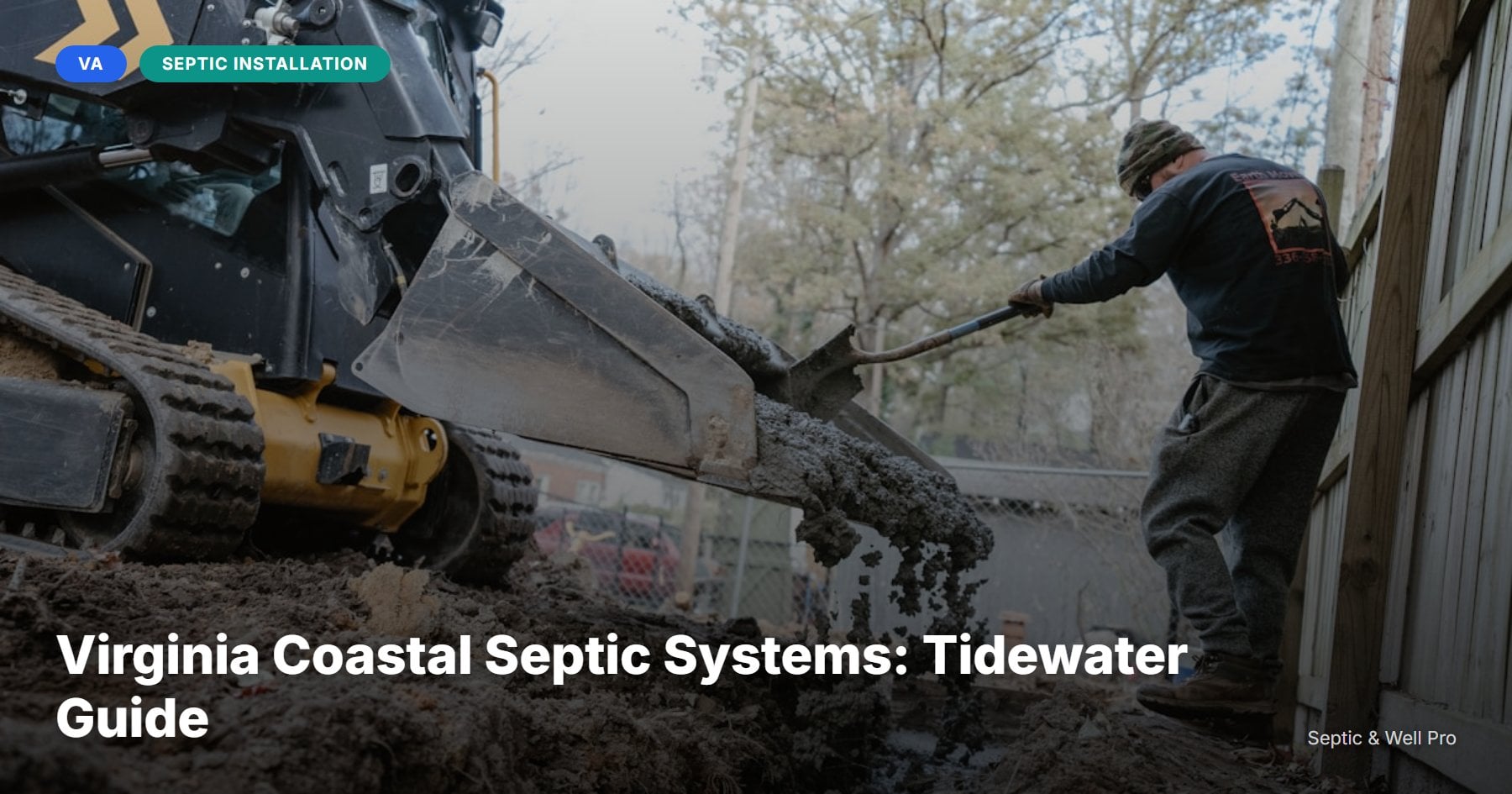
Virginia Coastal Septic Systems: Tidewater Guide
Virginia coastal septic systems guide for Tidewater homeowners. CBPA rules, high water table solutions, and flood-resistant system options.
Virginia coastal septic systems face challenges that inland systems never encounter. The Tidewater region — stretching from the Northern Neck south through Hampton Roads and including the Eastern Shore — sits on the Coastal Plain geological province where sandy soils, seasonally high water tables, and proximity to the Chesapeake Bay create a demanding environment for onsite wastewater treatment. Add in the Chesapeake Bay Preservation Act (CBPA) mandate for five-year pump-outs, rising sea levels, and increasing storm flooding, and Tidewater septic owners face a unique set of pressures.
Roughly 30% of homes in Virginia's Tidewater localities use septic systems instead of municipal sewer. That percentage climbs higher in rural areas like Gloucester County, Mathews County, the Eastern Shore, and the outer reaches of Chesapeake and Virginia Beach. These systems protect the Chesapeake Bay only if they function properly, which is why Virginia imposes stricter regulations on coastal septic systems than on their inland counterparts.
Why Tidewater Septic Systems Virginia Are Different
The tidewater septic systems Virginia homeowners maintain differ from inland systems in several fundamental ways driven by geology and regulation:
High water table. The Coastal Plain's sandy, flat terrain means groundwater often sits within two to four feet of the surface, rising even higher during wet seasons and storm events. Conventional gravity-fed drain fields need a minimum separation between the trench bottom and the seasonal high water table. When that separation does not exist, the VDH requires elevated or alternative systems — mound systems, low-pressure pipe (LPP), or aerobic treatment units (ATUs) with raised dispersal fields.
Sandy soils. While sandy soils drain quickly (which sounds good), they can actually drain too quickly for proper wastewater treatment. The effluent passes through the soil column so fast that bacteria and viruses do not get fully removed before reaching groundwater. This is the opposite problem from Piedmont clay, where water drains too slowly. Proper system design in Tidewater accounts for this rapid percolation.
CBPA regulations. Every locality in Virginia's Tidewater region falls under the Chesapeake Bay Preservation Act. The CBPA imposes requirements that do not apply to non-Tidewater counties, most notably the mandatory five-year pump-out for all septic systems. Localities must track compliance, and homeowners face fines for non-compliance. The CBPA also restricts development in Resource Protection Areas (RPAs) near waterways, which can limit where new septic systems can be placed.
Flooding and sea level rise. Tidewater Virginia experiences the highest rate of relative sea level rise on the U.S. East Coast — roughly 4.5 mm per year in Norfolk. Coastal flooding that was once rare now occurs regularly. When floodwater saturates a drain field, the system cannot treat wastewater effectively. Repeated flooding events can permanently damage drain field soil structure.
CBPA Septic Requirements Virginia: What You Must Know
The CBPA septic requirements Virginia imposes on Tidewater homeowners go beyond what inland counties require. Here are the key rules:
| Requirement | Details | Enforcement |
|---|---|---|
| Five-year pump-out | All septic tanks must be pumped every 5 years | Local government tracks compliance; fines for violation |
| Pump-out record filing | Pumper must file compliance report with the locality | Report due within 10 business days of pumping |
| HB 2671 inspection | Point-of-sale inspection for every property transfer | State law effective July 2025 |
| RPA setbacks | 100-foot buffer from perennial streams, wetlands, shorelines | Local zoning; exceptions require BMP plan |
| New system permits | VDH review with CBPA overlay considerations | ~$425 new, ~$225 repair |
The five-year pump-out rule catches many new Tidewater homeowners off guard. Unlike the rest of Virginia where pumping frequency is a recommendation, in CBPA localities it is a legal requirement. Your pumping contractor should file the compliance paperwork with your locality automatically — confirm this when scheduling service. Browse Virginia septic pumping providers who serve the Tidewater region to find CBPA-compliant pumpers.
Virginia Coastal Septic Systems: Common Types in Tidewater
The system types installed in Tidewater Virginia reflect the high water table and sandy soil challenges:
Mound systems. The most common alternative system in coastal Virginia. An engineered sand mound is built above grade, and effluent is pressure-dosed into the mound where the sand provides the treatment the natural soil cannot. Mound systems work well in Tidewater but require significant yard space and create a visible raised area. Cost: $12,000 to $25,000 in Virginia.
Low-pressure pipe (LPP) systems. Effluent is distributed through a network of small-diameter pipes under low pressure, spreading wastewater more evenly across the drain field than gravity trenches. LPP is effective in sandy Tidewater soils where even distribution prevents the localized overloading that gravity systems can cause. Cost: $10,000 to $18,000.
Aerobic treatment units (ATUs). ATUs produce cleaner effluent that requires less soil treatment, making them viable where soil depth is limited. In Tidewater, ATUs are often paired with an elevated dispersal system. They require quarterly inspections and ongoing mechanical maintenance. Cost: $12,000 to $25,000. Read our Virginia aerobic septic system guide for a detailed breakdown.
Conventional gravity systems. Still used on Tidewater properties where the water table sits more than four feet below the surface and soil conditions allow adequate treatment. These are the simplest and cheapest systems ($8,000 to $15,000) but only work on sites with sufficient vertical separation between the drain field and groundwater.
Protecting Your Tidewater Septic System From Flooding
Flooding is the biggest threat to virginia coastal septic systems. Here is how to protect your system before, during, and after flood events:
Before flooding. Keep your tank pumped on schedule — a full tank is more susceptible to floating and damage during flooding. Know where your septic components are located so you can assess them after the water recedes. Ensure riser lids are watertight to prevent floodwater from entering the tank. Consider installing check valves in the plumbing to prevent sewage from backing up into the house during floods.
During flooding. Reduce water use to the absolute minimum. Do not pump the tank while the ground is saturated — an empty tank in saturated soil can float out of the ground, destroying the system. Avoid walking or driving over the drain field, as saturated soil compacts easily and damages the absorption trenches.
After flooding. Wait until floodwater has fully receded and the ground has dried somewhat before pumping the tank. Have the system inspected by a DPOR-licensed professional before resuming normal use. The drain field may need weeks to fully recover — use water conservatively during this period. If sewage surfaced during the flooding, the area poses a health hazard and should be treated with lime or disinfectant.
For inspection services after a flood event, browse our Virginia septic inspection directory to find licensed professionals in the Tidewater region.
Frequently Asked Questions
How often must Tidewater Virginia homeowners pump their septic tank?
Every five years at minimum under the CBPA mandate. This is a legal requirement in all Tidewater CBPA localities, not a suggestion. Your locality tracks compliance and can impose fines for failing to pump on schedule. For a family of four with a 1,000-gallon tank, pumping every three years is even better for system longevity and bay protection.
Can I install a conventional septic system on a Tidewater property?
Only if the site evaluation shows sufficient separation between the drain field and the seasonal high water table, and the soil percolation rate falls within conventional parameters. Many Tidewater properties cannot meet these requirements, which is why alternative systems (mound, LPP, ATU) are so common in the region. The VDH soil evaluator makes this determination during the permit process.
What should I do if my septic system floods?
Minimize water use, do not pump the tank while the ground is saturated, and wait for the water to recede. After recession, have a DPOR-licensed contractor inspect the system before resuming normal use. The drain field may need several weeks to dry out and recover. If sewage surfaced, treat the area with lime and keep children and pets away.
Does sea level rise threaten my Tidewater septic system?
Yes. Rising sea levels and increasing tidal flooding raise the effective water table, reducing the vertical separation that septic systems depend on for treatment. Properties that were marginal for conventional systems when built may no longer meet requirements. If your system was installed decades ago and you are experiencing new drainage problems, the rising water table may be a contributing factor. A system evaluation can determine whether your system needs upgrades.
How much does a coastal septic system cost in Virginia?
Conventional systems on suitable Tidewater sites run $8,000 to $15,000. Mound systems and ATUs — more common on coastal properties — cost $12,000 to $25,000. The higher cost reflects the engineering required to handle high water tables and sandy soils. VDH permits add approximately $425 for new construction or $225 for repairs.
Find Coastal Septic Services in Virginia
Virginia coastal septic systems require contractors who understand the Tidewater's unique combination of sandy soils, high water tables, CBPA regulations, and flood risk. Start by browsing our directory for Virginia septic installation providers with Tidewater experience. For specific localities, check our pages for Chesapeake, Virginia Beach, Gloucester, and Suffolk to find contractors who work in your area.
For help understanding Virginia's septic rules, our Virginia septic regulations guide covers 12VAC5-610 and all statewide requirements.
Find Virginia providers
Connect with local professionals in Virginia for your septic or well water needs.
Related reading
 cost-guide
Well Pump Repair Cost Virginia (2026)
Well pump repair cost virginia homeowners pay ranges $300–$2,000+. Full pricing by repair type, region, and pump depth.
 city-guide
Best Septic Companies Suffolk VA (2026)
Best septic companies Suffolk VA homeowners rely on for pumping, CBPA compliance, inspections, and rural system repair.
 buyers-guide
Buying Home Septic System Virginia: HB 2671 Guide
Buying home septic system virginia? HB 2671 requires inspections. What buyers must check, costs, and red flags to watch.