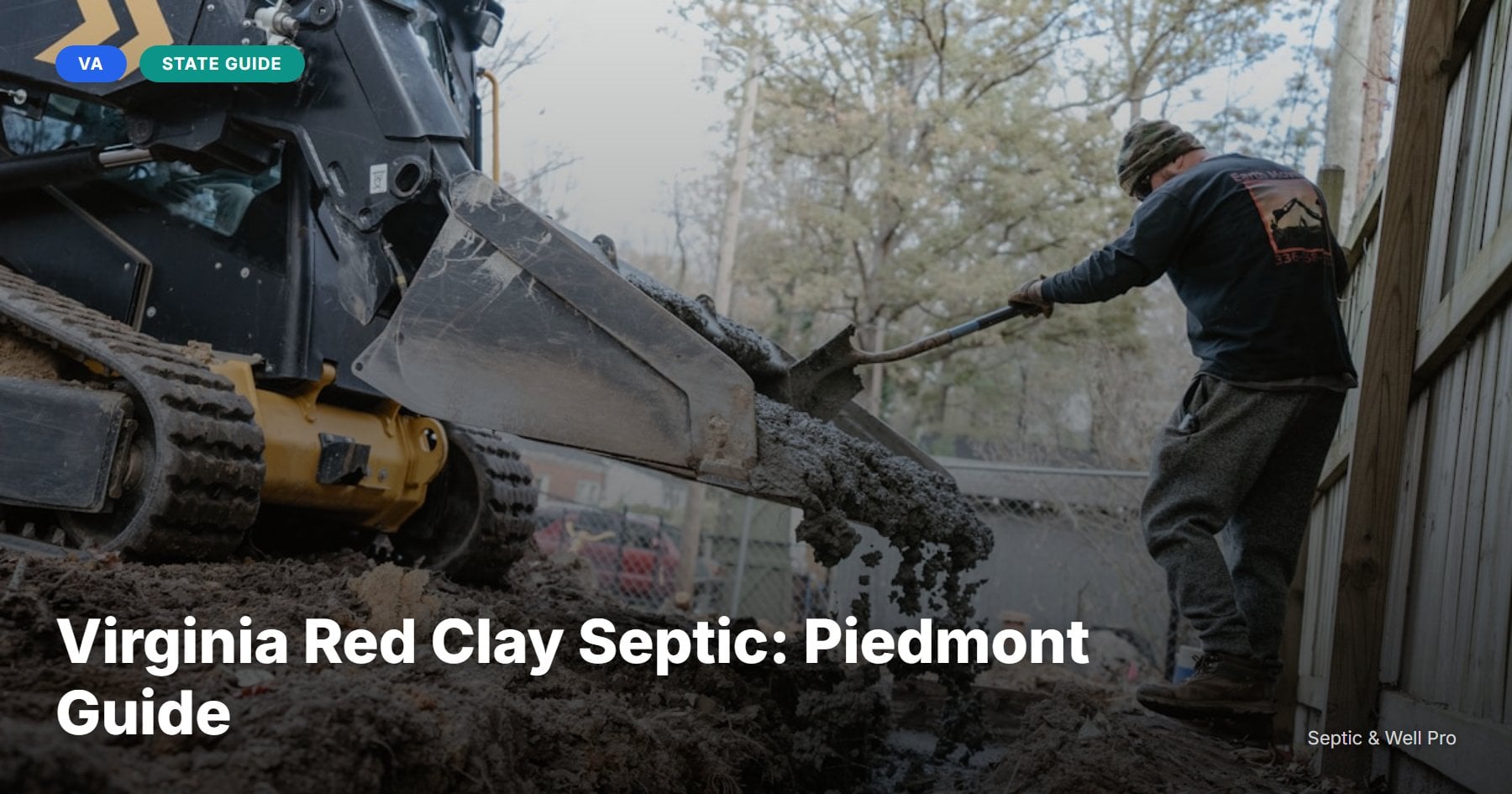
Virginia Red Clay Septic: Piedmont Guide
Virginia red clay septic challenges in the Piedmont region. System types, costs, and solutions for Cecil and Madison soils.
Virginia red clay septic challenges affect more homeowners than any other soil issue in the state. The Piedmont province — stretching from Northern Virginia through the central part of the state to the North Carolina border — is defined by heavy Cecil, Madison, and Appling series clays that slow water movement to a crawl. If you live in Loudoun, Fauquier, Culpeper, Orange, Albemarle, Campbell, Halifax, or any of the dozens of Piedmont counties, your septic system must contend with soils that actively resist the one thing a drain field needs to do: absorb and filter effluent.
This is not a minor inconvenience. Red clay's low percolation rate is the single biggest factor driving up septic costs and system complexity in central Virginia. Understanding how clay affects your system — and what solutions work — can save you thousands of dollars and years of frustration.
Why Virginia Red Clay Creates Septic Problems
Clay soils are made of microscopic flat particles that stack tightly together, leaving very little pore space for water to move through. When you dig a perc test hole in Cecil clay and fill it with water, you might wait 60, 90, or even 120+ minutes for the water level to drop one inch. Compare that to sandy Coastal Plain soils where the same inch drains in 5 to 15 minutes.
That slow drainage creates a cascade of problems for septic systems:
Drain field saturation. Effluent from the septic tank enters the drain field faster than the clay can absorb it. The distribution trenches become waterlogged, and the biomat (the bacterial layer that treats effluent) can become overwhelmed. This leads to surfacing — untreated or partially treated wastewater appearing on the ground surface above the drain field.
Seasonal variation. Piedmont clay soils expand when wet and shrink when dry, creating cracks in summer and sealing tight in winter. A system that functions adequately during dry summer months may struggle during the wet winter and spring seasons when the clay is saturated and swollen.
Root intrusion. Trees and shrubs are attracted to the moisture in drain fields, and their roots can penetrate distribution pipes and clog the system. In clay soils where the drain field stays wetter longer, root intrusion is more aggressive than in well-drained sandy soils.
Limited repair options. When a conventional drain field fails in clay, there is often nowhere to put a replacement that will work any better with the same technology. The soil has not changed — if conventional gravity failed once, it will fail again. Repairs in clay almost always require upgrading to alternative technology.
Septic System Types That Work in Virginia Red Clay
The VDH and DPOR-licensed designers have several proven solutions for virginia red clay septic installations. Each trades upfront cost for long-term reliability in challenging soils.
| System Type | How It Works | Cost Range | Best For |
|---|---|---|---|
| Low-Pressure Pipe (LPP) | Pump doses effluent through small-diameter pipes across a wide area | $12,000–$20,000 | Moderate clay (45–90 min perc) |
| Drip Irrigation | Timed micro-doses via drip tubing in shallow trenches | $15,000–$25,000 | Heavy clay (90+ min perc); slope constraints |
| Mound System | Elevated sand bed above native clay; gravity or pressure-dosed | $12,000–$22,000 | High water table with clay; flat terrain |
| Sand Filter + LPP | Pretreatment in sand filter before distribution to clay | $18,000–$30,000 | Worst clay conditions; limited space |
| Aerobic Treatment Unit (ATU) | Mechanical treatment produces cleaner effluent for clay distribution | $15,000–$28,000 | Small lots; environmentally sensitive areas |
The most common solution across the Virginia Piedmont is the low-pressure pipe (LPP) system. It spreads effluent thinly across a large area, giving the clay more time and surface area to absorb the load. DPOR-licensed designers in Loudoun, Fauquier, and Culpeper counties install LPP systems routinely.
Red Clay Drain Field Virginia: Repair and Replacement
When a red clay drain field Virginia fails, the repair process is different from failure in other soil types. Here is what to expect:
Assessment first. A DPOR-licensed operator or soil evaluator assesses the failure. In clay, the most common finding is drain field saturation — the native soil simply cannot handle the effluent volume. The evaluator will determine whether a repair can use the existing drain field footprint with upgraded technology or whether a new location is needed.
Technology upgrade is typical. If your failed system was a conventional gravity drain field (common in older Virginia homes built before current regulations), the replacement will almost certainly be an LPP, drip, or mound system. The soil has not improved since the original installation — only the technology has.
Reserve area is critical. Virginia regulations recommend designating a reserve drain field area at the time of original installation. If your property has a designated reserve area with acceptable soil conditions, the replacement can use that space. If no reserve area exists, the DPOR-licensed evaluator must find and certify a suitable location on your property — which may be challenging on smaller lots.
VDH permitting. All drain field repairs and replacements in Virginia require a VDH repair permit (~$225). The permit process includes soil evaluation, system design by a DPOR-licensed professional, construction by a DPOR-licensed installer, and final VDH inspection. Timeline: four to twelve weeks depending on the health district's workload.
Browse drain field repair services in Virginia to find contractors experienced with Piedmont clay soils.
Cost Differences: Piedmont vs. Other Virginia Regions
The Piedmont clay septic system premium is real and significant. Here is how costs compare across Virginia's geological provinces:
| Region / Soil Type | New System Cost | Notes |
|---|---|---|
| Coastal Plain (sandy) | $8,000–$12,000 | Conventional gravity often works; lowest cost |
| Piedmont (red clay) | $12,000–$25,000 | Alternative systems required; 50–100% premium |
| Valley/Ridge (limestone) | $10,000–$20,000 | Karst concerns; varies widely by site |
| Blue Ridge (mountain) | $12,000–$22,000 | Rock removal; steep slope engineering |
The Piedmont premium means homeowners in the clay belt pay 50 to 100 percent more than their Coastal Plain counterparts for comparable capacity. That is a $5,000 to $15,000 difference that comes directly from the soil conditions. See our Virginia septic installation cost guide for detailed pricing by region and system type.
Maintaining a Septic System on Virginia Red Clay
Clay soil systems need more attention than those on well-drained ground. Follow these maintenance practices to extend system life:
Pump more frequently. On clay, err toward the three-year end of the recommended range rather than five years. A cleaner tank sends less solid material to the drain field, reducing the workload on already-stressed clay soils.
Fix leaks and reduce water use. Every gallon that enters your septic system must be absorbed by the clay. A running toilet or leaking faucet can add 200+ gallons per day — enough to overwhelm a marginal drain field. Fix leaks promptly and consider high-efficiency fixtures.
Protect the drain field surface. Never park vehicles on the drain field, and keep heavy equipment away. Clay compacts easily, and compacted clay drains even slower. Also avoid planting trees or deep-rooted shrubs within 20 feet of the drain field.
Monitor after heavy rain. Check for ponding water or sewage odor above the drain field after extended rain. Clay soil systems are more vulnerable during wet periods. If you see consistent surfacing during winter months, it may be time for a professional assessment.
Frequently Asked Questions
Can a conventional septic system work in Virginia red clay?
Rarely. Conventional gravity drain fields require percolation rates faster than 60 minutes per inch. Most Cecil and Madison series clays in the Virginia Piedmont test at 60 to 120+ minutes per inch. Some sites with mixed soil profiles or weathered surface clay may barely qualify, but most Piedmont installations require alternative technology like LPP or drip irrigation. A DPOR-licensed soil evaluator's perc test results determine what your specific property can support.
How much more does a septic system cost on clay vs. sand in Virginia?
The clay soil septic problems VA homeowners face translate to a 50 to 100 percent cost premium. A system that costs $8,000 to $12,000 on Coastal Plain sand will run $12,000 to $25,000 on Piedmont clay. The difference comes from alternative system technology, larger drain field footprints, and more complex engineering required by the challenging soil.
Why does my drain field surface water after rain on clay soil?
Clay becomes virtually impermeable when saturated. After heavy rain, the clay around your drain field swells and seals, preventing effluent absorption. Wastewater has nowhere to go, so it surfaces. Short-duration surfacing after major storms is common on clay and does not necessarily mean your system has failed. Persistent surfacing that lasts days or occurs without recent heavy rain signals a problem requiring professional evaluation.
What is the best septic system for Virginia Piedmont red clay?
Low-pressure pipe (LPP) is the most common and cost-effective solution for moderate Piedmont clays. For the heaviest clays or constrained lots, drip irrigation systems provide the most controlled dosing. Mound systems work well on flat terrain with high water tables combined with clay. Your DPOR-licensed designer recommends the best option based on your soil evaluation, lot size, and terrain.
Find Septic Professionals Experienced With Piedmont Clay
Virginia red clay septic work requires contractors who deal with clay daily — not occasionally. Browse Virginia septic installation providers to find DPOR-licensed installers in the Piedmont region. For failing drain fields, visit our drain field repair directory to find specialists who can assess your clay soil system and recommend the right upgrade.
Find Virginia providers
Connect with local professionals in Virginia for your septic or well water needs.
Related reading
 city-guide
Best Septic Companies Mechanicsville VA (2026)
Find the best septic companies Mechanicsville VA has for pumping, inspections, and drain field repair. Hanover County tips and pricing.
 city-guide
Best Septic Companies Chesapeake VA (2026)
Find the best septic companies Chesapeake VA has for pumping, inspections, and repair. Local tips and what to look for.
 comparison
Septic vs Sewer Cost Virginia Comparison
Septic vs sewer cost virginia comparison covering installation, maintenance, and 20-year totals. Which saves money?