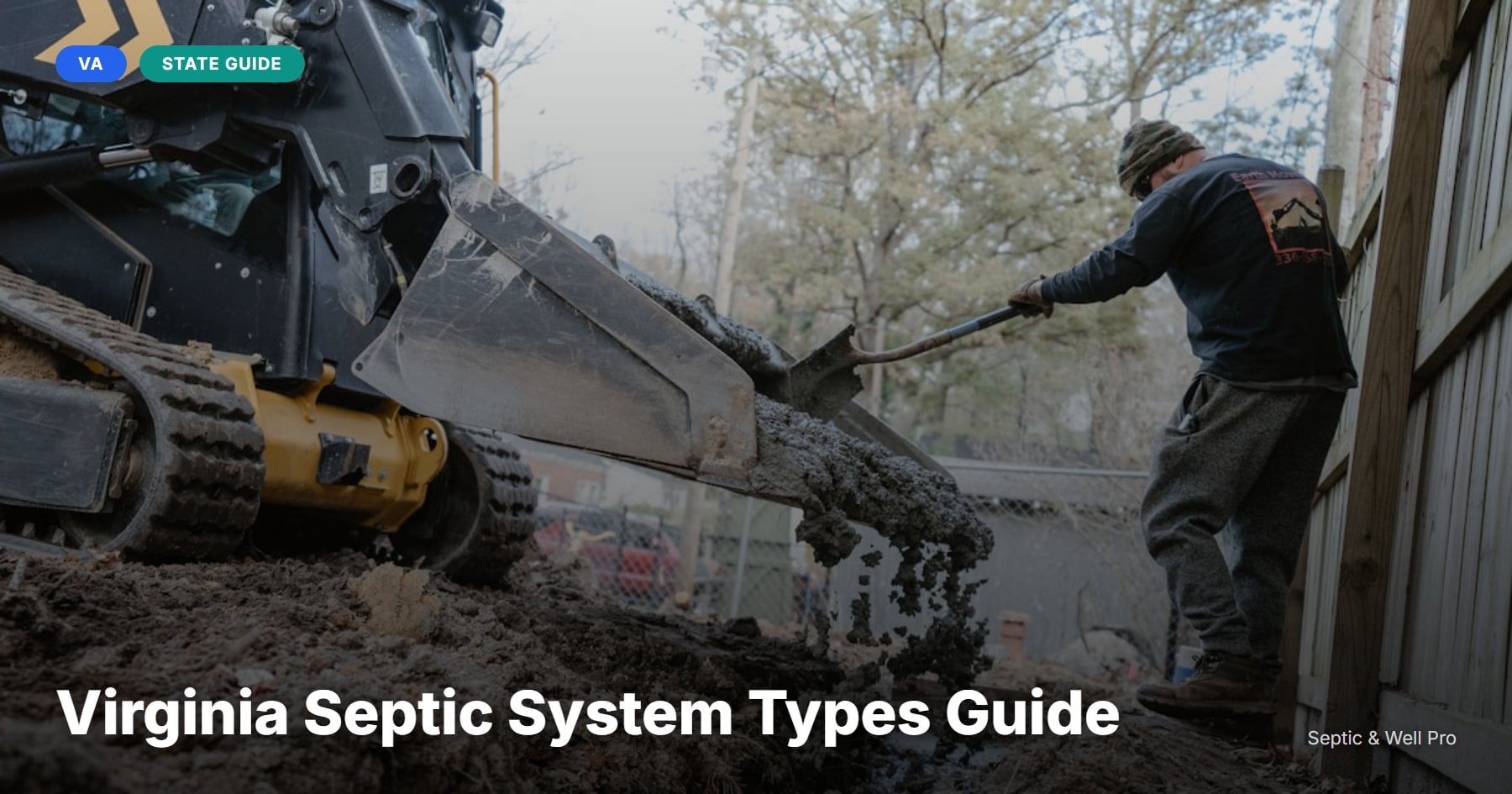
Virginia Septic System Types Guide
Virginia septic system types include conventional, LPP, mound, drip, and aerobic units. Which one fits your property.
Virginia septic system types range from basic gravity-fed tanks to advanced treatment units with real-time monitoring. The system your property needs depends entirely on what the soil evaluation reveals — you do not get to pick your favorite from a menu. Virginia's 12VAC5-610 regulations tie system approval to site conditions evaluated by a DPOR-licensed soil evaluator, and the range of conditions across the state is enormous.
Sandy Coastal Plain soils drain differently than Piedmont red clay. Karst limestone in the Shenandoah Valley poses risks that mountain bedrock in the Blue Ridge does not. Understanding the major virginia septic system types helps you make sense of what the evaluator recommends and what it will cost to build.
Virginia Septic System Types: Conventional Gravity
The workhorse of Virginia's onsite wastewater treatment. A conventional gravity system uses a septic tank connected to a drain field (absorption field) where effluent percolates through the soil. Gravity does the work — no pumps, no electricity, no moving parts beyond the effluent filter.
Conventional systems work best in well-drained soils with at least 18 to 24 inches of suitable soil above a limiting layer (bedrock, water table, or impermeable clay). The Piedmont's better-drained upland soils and many Coastal Plain areas support conventional systems, though site-specific evaluation is always required.
| Feature | Detail |
|---|---|
| Best for | Well-drained soils, adequate vertical separation |
| Installation cost | $4,000–$8,000 |
| Maintenance | Pump every 3–5 years, inspect effluent filter annually |
| Lifespan | 20–30 years with proper maintenance |
| Common regions | Piedmont uplands, parts of Coastal Plain |
Low-Pressure Pipe (LPP) Systems
When gravity alone cannot distribute effluent evenly — due to slopes, irregular lot shapes, or marginal soil depth — an LPP system uses a pump to push effluent through small-diameter pipes with drilled holes across the drain field. The pressurized distribution ensures even loading across the entire absorption area.
LPP systems are common in the Piedmont where clay soils and rolling terrain make conventional gravity distribution unreliable. They are also frequently used in Loudoun County and Culpeper County where development on marginal soils has increased demand for engineered solutions.
| Feature | Detail |
|---|---|
| Best for | Marginal soils, uneven terrain, clay soils |
| Installation cost | $7,000–$15,000 |
| Maintenance | Pump every 3–5 years plus annual pump/controls check |
| Lifespan | 20–25 years |
| Common regions | Piedmont, Northern Virginia, mountain foothills |
Mound Systems
Mound systems solve the problem of high water tables or shallow bedrock by building the drain field above the natural grade. An engineered sand mound sits on top of the existing soil surface, and effluent is pumped up into it. The mound provides the vertical separation that the natural soil lacks.
The Tidewater region's high water tables make mound systems a common sight in Chesapeake, Virginia Beach, and surrounding areas. They are also used in mountain areas where bedrock sits close to the surface.
| Feature | Detail |
|---|---|
| Best for | High water table, shallow bedrock |
| Installation cost | $10,000–$25,000 |
| Maintenance | Pump every 3–5 years, inspect mound surface annually |
| Lifespan | 15–25 years |
| Common regions | Tidewater, Eastern Shore, mountain areas |
Drip Irrigation Systems
Drip systems use small-diameter tubing with emitters to distribute treated effluent over a large area at shallow depths. They require advanced pretreatment (usually an aerobic treatment unit) before the drip field. The flexibility of drip tubing allows installation on virtually any site — steep slopes, shallow soils, wooded lots, and small properties.
Drip systems are among the most expensive virginia septic system types but work where nothing else can. As an alternative septic virginia solution, they are increasingly common on difficult sites in the Blue Ridge and Shenandoah Valley. Among all septic systems virginia properties use, drip offers the most flexibility on challenging terrain.
| Feature | Detail |
|---|---|
| Best for | Any soil type, difficult terrain, small lots |
| Installation cost | $15,000–$30,000 |
| Maintenance | Quarterly filter cleaning, annual professional service |
| Lifespan | 15–20 years |
| Common regions | Mountain counties, difficult sites statewide |
Aerobic Treatment Units (ATUs)
ATUs introduce oxygen into the treatment process, creating conditions that break down waste much faster than a conventional anaerobic tank. The result is cleaner effluent that can be discharged into smaller or more challenging drain fields. ATUs are often paired with drip or spray distribution systems.
Virginia requires ATUs to have a maintenance contract with a DPOR-licensed operator for the life of the system. This adds ongoing annual costs of $200 to $500 beyond standard pumping, but the trade-off is a system that works on properties where passive treatment cannot.
| Feature | Detail |
|---|---|
| Best for | Sites requiring advanced treatment, small lots |
| Installation cost | $12,000–$25,000 |
| Maintenance | Mandatory annual service contract, quarterly inspections |
| Lifespan | 15–20 years (mechanical components may need earlier replacement) |
| Common regions | CBPA localities, environmentally sensitive areas |
How to Know Which System Type Your Property Needs
You will not know until the soil evaluation is complete. A DPOR-licensed onsite soil evaluator digs test pits, evaluates soil horizons, measures depth to bedrock and water table, and assesses slope. The evaluation results determine which virginia septic system types are viable for your property.
Some properties qualify for multiple system types, giving you a choice based on budget and maintenance preferences. Others — particularly challenging sites in karst terrain or with very high water tables — may have only one viable option. Your evaluator and the VDH health district work together to determine what is approved.
Get quotes from multiple DPOR-licensed installers once you know your system type. Prices for the same system type can vary by 30 to 50 percent between contractors. Browse septic installation companies in Virginia to start comparing options.
Frequently Asked Questions
Can I choose which septic system type to install in Virginia?
Only if your site supports multiple options. The soil evaluation determines which systems are viable. If your property supports both conventional and LPP, you can choose based on cost and preference. If only one type passes the site evaluation, that is what you build.
Which septic system type is cheapest in Virginia?
Conventional gravity systems are the least expensive at $4,000 to $8,000 installed. They also have the lowest maintenance costs since they require no electricity or mechanical components. Not every property can support one — clay soils, high water tables, and shallow bedrock often disqualify conventional designs.
Do alternative septic systems require more maintenance in Virginia?
Yes. LPP, drip, mound, and aerobic systems all have mechanical components (pumps, controls, treatment units) that need regular professional service. Virginia requires a maintenance contract for ATUs and many alternative systems. Budget $200 to $500 per year for professional maintenance beyond standard tank pumping.
How long do septic systems last in Virginia?
Conventional gravity systems can last 20 to 30 years with proper maintenance. Alternative systems with mechanical components typically last 15 to 25 years, with pumps and controls needing replacement earlier. The tank itself can outlast the drain field by a decade or more. Regular pumping and maintenance are the biggest factors in system longevity.
Find a Licensed Septic Installer in Virginia
Choosing the right installer matters as much as choosing the right system. A DPOR-licensed professional who regularly works with your system type and understands your region's soil conditions will deliver a better installation. Our directory lists verified Virginia installers with their service areas and specializations.
Browse septic installers in Virginia by county to compare qualified contractors near you.
Find Virginia providers
Connect with local professionals in Virginia for your septic or well water needs.
Related reading
 city-guide
Best Septic Companies Mechanicsville VA (2026)
Find the best septic companies Mechanicsville VA has for pumping, inspections, and drain field repair. Hanover County tips and pricing.
 city-guide
Best Septic Companies Chesapeake VA (2026)
Find the best septic companies Chesapeake VA has for pumping, inspections, and repair. Local tips and what to look for.
 comparison
Septic vs Sewer Cost Virginia Comparison
Septic vs sewer cost virginia comparison covering installation, maintenance, and 20-year totals. Which saves money?