Well Pump Replacement Cost PA: Repair vs Replace Guide
Well pump replacement cost PA homeowners pay ranges from $800 to $4,500+ depending on pump type and well depth. Use our repair vs replace framework to decide.
That sputtering faucet and dropping water pressure just earned you a contractor quote for $2,800 — and now you're wondering whether full replacement is really necessary or if a cheaper repair could buy you more time. For Pennsylvania's 870,000 private well households, well pump replacement cost PA-wide falls between $800 and $4,500, but the real question isn't just how much. It's whether replacement is the right move at all.
This guide breaks down PA well pump replacement pricing by pump type and well depth, walks you through a repair vs replace decision framework, and flags the warning signs that mean replacement is your only smart option.
PA Well Pump Replacement Price: Quick Overview
Before getting into the details, here's what Pennsylvania homeowners typically pay for well pump replacement in 2026.
| Replacement Type | Typical Cost Range | PA Average |
|---|---|---|
| Submersible pump (under 150 ft) | $1,200–$2,500 | $1,800 |
| Submersible pump (150–300 ft) | $2,000–$3,500 | $2,700 |
| Submersible pump (300+ ft) | $3,000–$4,500+ | $3,800 |
| Jet pump (shallow well) | $800–$1,800 | $1,200 |
| Constant pressure system upgrade | $2,500–$5,000 | $3,500 |
These figures include the pump, drop pipe, wiring, labor, and standard fittings. They don't include well rehabilitation, pressure tank replacement, or water treatment equipment — those add $300 to $2,000+ depending on what's needed.
New Well Pump Cost PA: Breakdown by Component
A well pump replacement isn't just the pump itself. Multiple components get swapped during the job, and understanding each one helps you evaluate whether a contractor's quote is fair.
Submersible Pump Unit
The pump is the single most expensive component. Standard residential submersible pumps in PA range from $400 for a basic 1/2 HP unit to $1,200+ for a 1 HP variable-speed model. Most PA homes with wells under 250 feet use 1/2 to 3/4 HP pumps. Deeper wells or homes with higher water demand need 1 HP or larger units.
Brand matters for longevity. Franklin Electric, Goulds (Xylem), and Grundfos are the three brands most PA well contractors install. Franklin Electric dominates the residential market — their motors are standard across multiple pump manufacturers. Expect to pay a 15–25% premium for Grundfos constant-pressure systems, but they deliver steadier water pressure and can extend pump life by reducing cycling stress.
Drop Pipe and Wiring
The drop pipe connects the pump to the surface. Wiring runs alongside it. Both are typically replaced during a pump swap because reusing old pipe and wire risks contaminating the new pump with corrosion debris or creating an electrical failure within months.
| Component | Cost Per Foot | 100 ft Well | 200 ft Well | 300 ft Well |
|---|---|---|---|---|
| Drop pipe (PVC or poly) | $2–$5 | $200–$500 | $400–$1,000 | $600–$1,500 |
| Submersible wire | $1–$3 | $100–$300 | $200–$600 | $300–$900 |
| Torque arrestor, splice kit | Flat fee | $50–$100 | $50–$100 | $50–$100 |
Depth is the biggest cost driver in PA well pump replacement. A 300-foot well requires three times the material and significantly more labor time than a 100-foot well. If you don't know your well depth, check your well completion report — PA DEP requires drillers to file one. Your county conservation district office should have a copy.
Labor Costs
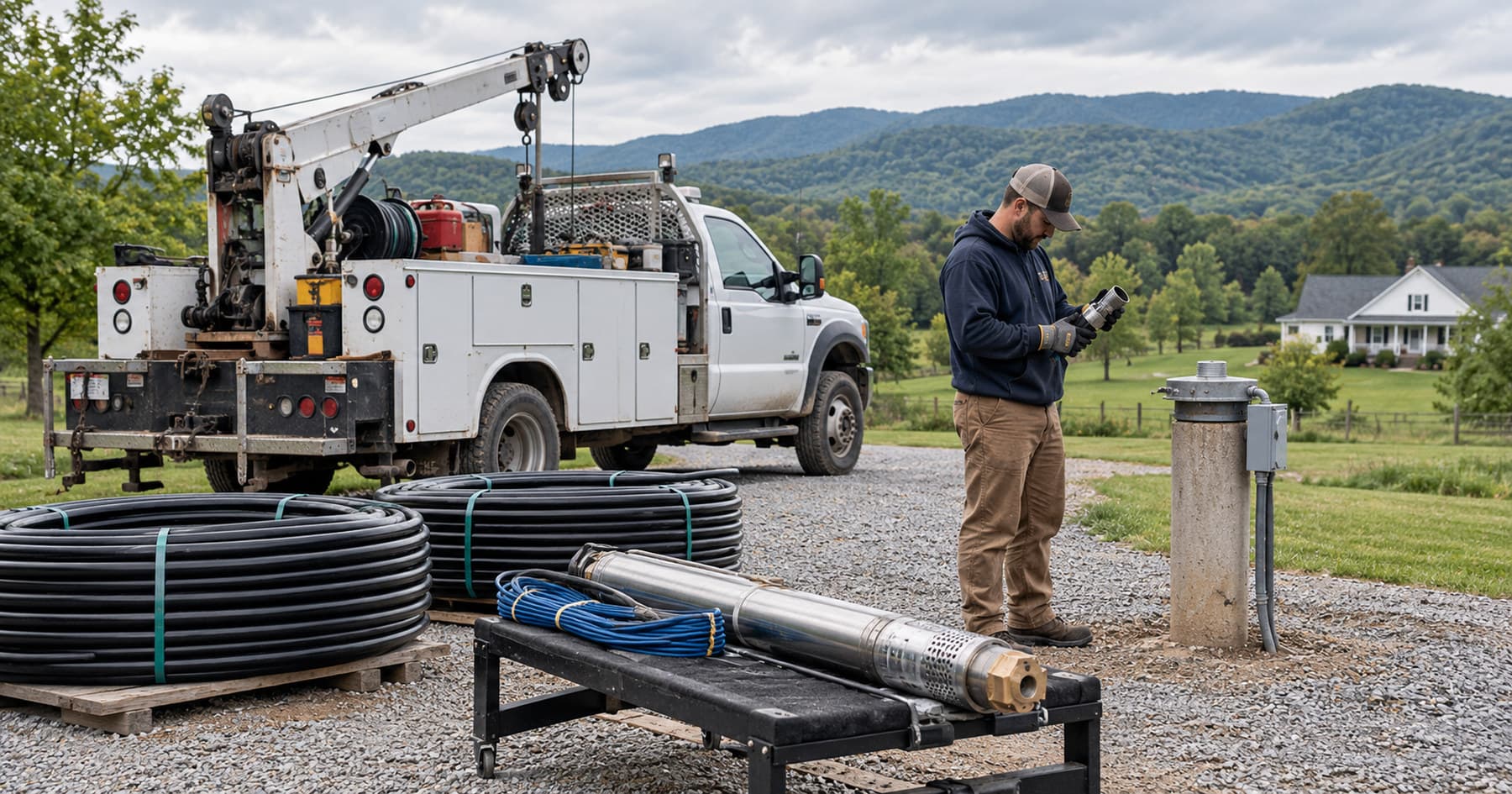
Pulling a submersible pump from a deep well requires a truck-mounted pulling rig, two technicians, and typically 3 to 6 hours of on-site work. Labor rates for well pump replacement in PA range from $75 to $150 per hour depending on your region.
The Philadelphia suburbs and Lehigh Valley tend to run higher — $100 to $150 per hour — while rural central PA and the northern tier fall closer to $75 to $100. The Poconos split the difference, with tourist-area premiums pushing rates closer to metro levels during peak season.
Well Pump Repair vs Replace Pennsylvania: Decision Framework
Not every pump problem requires full replacement. But continuing to repair a failing pump can cost more in the long run than replacing it outright. Here's a structured way to think through the decision.
The 50% Rule
If the repair estimate exceeds 50% of full replacement cost, replace the pump. A $1,200 repair on a system that costs $2,400 to replace completely is poor economics — you're paying half the price for a used pump that could fail again within a year or two.
The Age Factor
| Pump Age | Recommended Action | Why |
|---|---|---|
| Under 5 years | Repair (check warranty first) | Pump has 5–10+ years of expected life remaining. Most manufacturers offer 5-year warranties. |
| 5–10 years | Repair if cost is under 40% of replacement | Pump has useful life left, but the economics of major repair get questionable. |
| 10–15 years | Replace unless repair is minor ($300 or less) | Pump is approaching end of life. Major repairs are wasted money. |
| 15+ years | Replace regardless of repair feasibility | You're on borrowed time. Proactive replacement avoids emergency pricing. |
Repair-Worthy Problems
These issues typically justify repair over replacement.
- Pressure switch failure — $100 to $300. The switch is above ground and easy to replace.
- Pressure tank bladder failure — $300 to $800. This is a tank problem, not a pump problem. Replacing the tank fixes the short-cycling.
- Control box capacitor or relay — $150 to $400. Surface-mounted components that don't require pulling the pump.
- Corroded wire connection at wellhead — $100 to $250. Accessible without pulling the pump from the well.
Replace-Worthy Problems
These conditions almost always mean replacement is the better path.
- Motor failure — The motor is sealed inside the pump housing at the bottom of the well. Motor replacement costs nearly as much as full pump replacement once you add pulling costs.
- Worn impellers — Gradual pressure loss from impeller erosion means the pump can't recover. Common in PA wells with high sediment or iron content, especially in the limestone belt running through central Pennsylvania.
- Broken drop pipe — If the pipe failed, the pump dropped deeper into the well. Fishing it out, inspecting it, and reinstalling costs almost as much as pulling, replacing, and installing new equipment.
- Sand or sediment production — A deteriorated intake screen or a pump that has dropped means replacement with a properly positioned new pump and screen.
What Drives Well Pump Replacement Cost in Pennsylvania
Well Depth
Depth is the single biggest factor. Every foot of well depth adds $3 to $8 in material and labor costs. A 100-foot well might cost $1,500 for complete submersible replacement. That same job in a 400-foot well can hit $5,000+ because of the exponentially greater pipe, wire, pulling time, and equipment requirements.
PA well depths vary significantly by region. The Piedmont area (Chester, Lancaster, Montgomery counties) typically has wells in the 100- to 250-foot range. The Appalachian Ridge and Valley (Huntingdon, Mifflin, Centre counties) runs deeper — 200 to 400 feet is common. The northeastern Poconos region averages 150 to 300 feet depending on local geology.
Pump Type and Horsepower
A standard 1/2 HP submersible pump costs roughly half what a 1 HP unit costs. Constant-pressure (variable frequency drive) systems cost 2 to 3 times more than standard pumps but deliver better performance and can reduce electrical costs over time.
Emergency vs Scheduled Service
Emergency well pump replacement — when you wake up with no water on a Saturday morning — typically costs 25–50% more than scheduled replacement. Weekend and holiday rates in PA run $125 to $200 per hour versus standard weekday rates. If your pump is over 12 years old and still running, scheduling a proactive replacement during a weekday could save you $500 to $1,000 compared to waiting for it to fail.
Well Condition
Older PA wells sometimes need rehabilitation during pump replacement. If the well hasn't been serviced in decades, the casing may have mineral deposits restricting flow, or the well screen could be deteriorated. Well rehabilitation adds $500 to $2,000 to the project but ensures the new pump operates at full efficiency.
PA Well Pump Replacement Cost by Region
| PA Region | Typical Total Cost | Average Well Depth | Notes |
|---|---|---|---|
| Philadelphia suburbs (Chester, Montgomery, Bucks) | $2,200–$3,800 | 100–250 ft | Higher labor rates, moderate well depths |
| Lehigh Valley (Lehigh, Northampton) | $2,000–$3,500 | 150–300 ft | Limestone geology, variable depths |
| Poconos (Monroe, Pike, Wayne) | $1,800–$3,200 | 150–300 ft | Seasonal demand affects scheduling |
| Central PA (Centre, Huntingdon, Blair) | $1,500–$3,000 | 200–400 ft | Deeper wells but lower labor rates |
| Pittsburgh suburbs (Allegheny, Westmoreland) | $2,000–$3,500 | 100–250 ft | Metro labor premiums |
| Northern Tier (Bradford, Tioga, Sullivan) | $1,400–$2,800 | 100–250 ft | Lowest labor rates, rural access |
| South-central (Lancaster, York, Adams) | $1,800–$3,200 | 100–300 ft | Agricultural areas, variable water quality |
These ranges reflect total installed cost including pump, pipe, wire, and labor. Actual costs depend on your specific well depth, pump size needed, and whether additional work (pressure tank, well rehab) is required.
How to Get a Fair Quote for PA Well Pump Replacement
Get at least two written quotes from PA-registered well contractors. Every quote should itemize the pump brand and model, horsepower, pipe type and length, wire gauge and length, labor hours, and any additional components like a pitless adapter or pressure tank.
Watch out for lump-sum quotes that don't break down the components. A reputable contractor has nothing to hide and will explain exactly what you're paying for. Ask whether the quote includes pulling the old pump — some contractors charge the pulling fee separately, which makes their initial quote look lower but ends up costing the same or more.
Verify that any contractor you hire is registered with PA DEP for well work. Pennsylvania requires well drillers to be licensed through the Department of Conservation and Natural Resources (DCNR), and most legitimate pump installers carry this credential.
You can browse well pump service providers in Pennsylvania in our directory to find contractors in your county with the right qualifications.
Frequently Asked Questions About Well Pump Replacement Cost in PA
How much does it cost to replace a well pump in Pennsylvania?
Most PA homeowners pay between $1,200 and $3,500 for submersible well pump replacement, with the statewide average around $2,400. Shallow jet pump replacement costs less — typically $800 to $1,800. Well depth is the biggest cost factor. A 300-foot well costs roughly twice as much to service as a 100-foot well due to material and labor requirements.
Is it worth repairing a well pump or should I just replace it?
Follow the 50% rule: if the repair costs more than half the price of replacement, replace it. Pump age matters too. Repairs make financial sense on pumps under 10 years old when the fix is a surface component like a pressure switch or control box. For pumps over 10 years old with motor or impeller problems, replacement is almost always the smarter investment.
How long does a well pump last in Pennsylvania?
Submersible well pumps in PA typically last 8 to 15 years. Water quality significantly affects lifespan — wells with high iron, manganese, or sediment content in central and south-central PA wear pumps faster. Jet pumps last 10 to 20 years. Constant-pressure systems may have shorter pump life due to more continuous operation but deliver better performance during their service life.
Does homeowners insurance cover well pump replacement in PA?
Standard Pennsylvania homeowners insurance policies do not cover well pump replacement due to normal wear and mechanical failure. Some policies cover damage caused by a specific covered event — a lightning strike that fries the pump motor, for example. Equipment breakdown endorsements are available from some carriers for an additional premium and may cover sudden mechanical failure. Check your policy or call your agent to confirm your specific coverage.
Can I replace a well pump myself in Pennsylvania?
Jet pump replacement is feasible for a skilled homeowner since the pump sits above ground. Submersible pump replacement requires a motorized pulling rig to extract hundreds of feet of pipe and wire from the well bore — this is professional-grade equipment that most homeowners don't own and shouldn't attempt without experience. Improper installation can drop the pump, damage the well casing, or create cross-contamination risks.
Find a Well Pump Contractor in Pennsylvania
Whether you've decided on repair or replacement, working with a PA-registered well contractor ensures the job is done right. Our directory lists well pump service companies across Pennsylvania with service areas, credentials, and contact information so you can compare providers in your county.
Browse by service:
- Well Pump Repair and Replacement in PA
- All Well and Septic Providers in Pennsylvania
- Well Pump Repair in Pennsylvania: Cost and Guide
Related Articles
Find Pennsylvania providers
Connect with local professionals in Pennsylvania for your septic or well water needs.
Related reading
 cost-guide
Well Pump Repair Cost Virginia (2026)
Well pump repair cost virginia homeowners pay ranges $300–$2,000+. Full pricing by repair type, region, and pump depth.
 cost-guide
Well Pump Repair Cost South Carolina (2026)
Well pump repair cost south carolina ranges $200-$800 for repairs, $1,000-$3,000+ for replacement. SC pricing by pump type and depth.
 cost-guide
Well Pump Repair Cost NC: 2026 Pricing Guide
How much is well pump repair cost NC homeowners pay in 2026? Submersible pump repair, replacement, and emergency service call pricing.