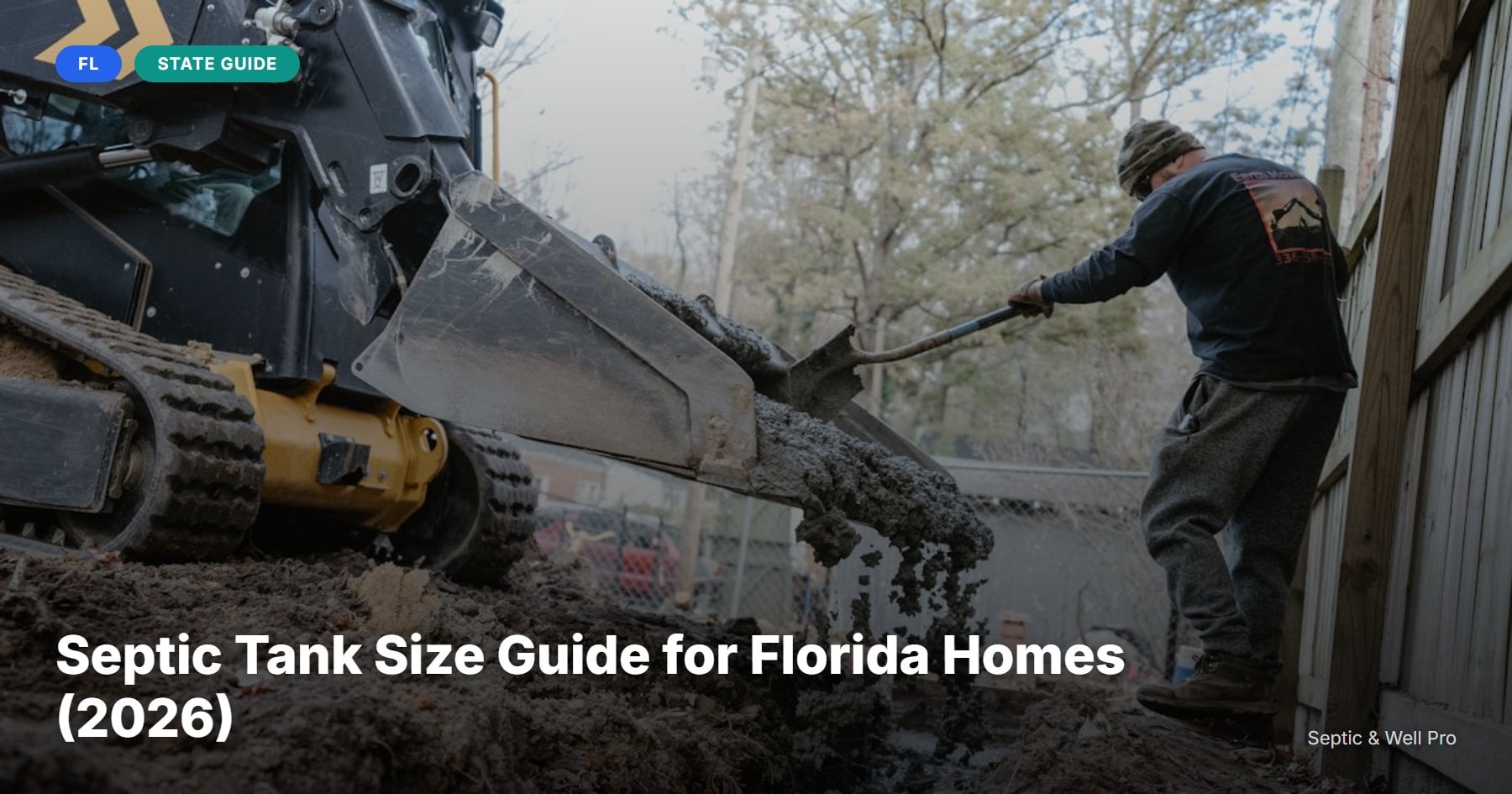
Septic Tank Size Guide for Florida Homes (2026)
Florida septic tank size requirements start at 900 gallons for 2-bedroom homes, with sizing based on 120 GPD per bedroom. See FL DEP minimums, tank materials, and high water table considerations.
Choosing the right florida septic tank size comes down to one number: bedrooms. Florida's Department of Environmental Protection (DEP) ties minimum tank capacity directly to bedroom count, using a 120 gallons-per-day (GPD) per bedroom standard under Florida Statute 381.0065 and Florida Administrative Code 64E-6. A 3-bedroom home needs at least a 1,050-gallon tank. Go smaller and your county DOH won't approve the permit. Go larger and you get extra buffer for peak usage — which matters in a state where houseguests and seasonal residents can double a home's wastewater output overnight.
But bedroom count is just the starting point. Florida's geology adds layers of complexity that most sizing guides skip. High water tables across South Florida limit which tank materials and configurations work. Springs protection zones mandate Enhanced Nutrient Reduction (ENR) systems with their own sizing rules.
And replacing an aging tank often means upsizing to current code, not just swapping like-for-like. Here's how florida septic tank size rules actually work in practice.
Florida Septic Tank Size Requirements by Bedrooms
The FL DEP sets minimum septic tank capacities based on estimated daily wastewater flow. The baseline is 120 GPD per bedroom, regardless of how many people actually live in the home. A bedroom is any room that could function as a sleeping area — even if you're using it as an office.
| Bedrooms | Estimated Daily Flow (GPD) | Minimum Tank Size (Gallons) | Common Installed Size |
|---|---|---|---|
| 1 | 120 | 900 | 900 |
| 2 | 240 | 900 | 900–1,050 |
| 3 | 360 | 1,050 | 1,050–1,250 |
| 4 | 480 | 1,250 | 1,250–1,500 |
| 5 | 600 | 1,500 | 1,500–1,800 |
| 6 | 720 | 1,800 | 1,800–2,000 |
These are minimums. Most contractors in Florida recommend going one size up from the minimum, especially for homes with garbage disposals, jetted tubs, or multiple bathrooms. A garbage disposal alone can increase solids loading by 30% to 50%, which shortens pumping intervals on a minimum-sized tank.
For homes with more than 6 bedrooms, FL DEP requires engineered system designs with flow calculations that account for actual fixtures and anticipated occupancy. These projects go through a professional engineer rather than the standard permit pathway.
How Florida Calculates Septic Tank Size
Florida's sizing formula follows a straightforward logic, but the details trip up homeowners who compare notes across state lines.
The 120 GPD Standard
Each bedroom generates an assumed 120 gallons of wastewater per day. This accounts for toilets, showers, sinks, laundry, and dishwashers. Florida uses bedrooms rather than occupancy because bedroom count stays constant when the house changes hands — you can't downsize a septic system just because a couple bought a 4-bedroom house.
The 120 GPD figure is conservative by design. Actual usage for a family of four runs closer to 200 to 300 GPD total. But the per-bedroom method ensures the system handles peak scenarios: a full house, guests staying for the holidays, or a rental property at max occupancy.
Retention Time and Tank Capacity
Tank sizing isn't just about daily flow — it's about retention time. Solids need roughly 24 to 48 hours to settle in the tank before liquid effluent moves to the drain field. A tank that's too small pushes partially treated wastewater into the absorption area, which clogs the drain field soil over time. That's the failure mode you're trying to avoid, and it's exactly why FL DEP sets minimums with enough volume for adequate settling.
The minimum tank sizes in the table above already factor in the 24-hour retention requirement at design flow. Going larger adds safety margin — a 1,250-gallon tank on a 3-bedroom home gives you nearly 3.5 days of retention at typical usage rather than just under 3 days at the minimum 1,050 gallons.
Septic Tank Size Florida: Which Materials Work Best
Three tank materials dominate the Florida market, and the choice depends on your site conditions, budget, and access constraints.
| Material | Cost Range (1,050 gal) | Lifespan | Best For | Drawbacks |
|---|---|---|---|---|
| Precast concrete | $800–$1,800 | 30–50 years | Most FL installations | Heavy; needs crane for delivery |
| Fiberglass | $1,500–$3,000 | 30–40 years | High water table, limited access | Can float if not properly anchored |
| Polyethylene (plastic) | $1,200–$2,500 | 20–30 years | Remote or tight-access sites | Floatation risk; less structural strength |
Concrete Tanks
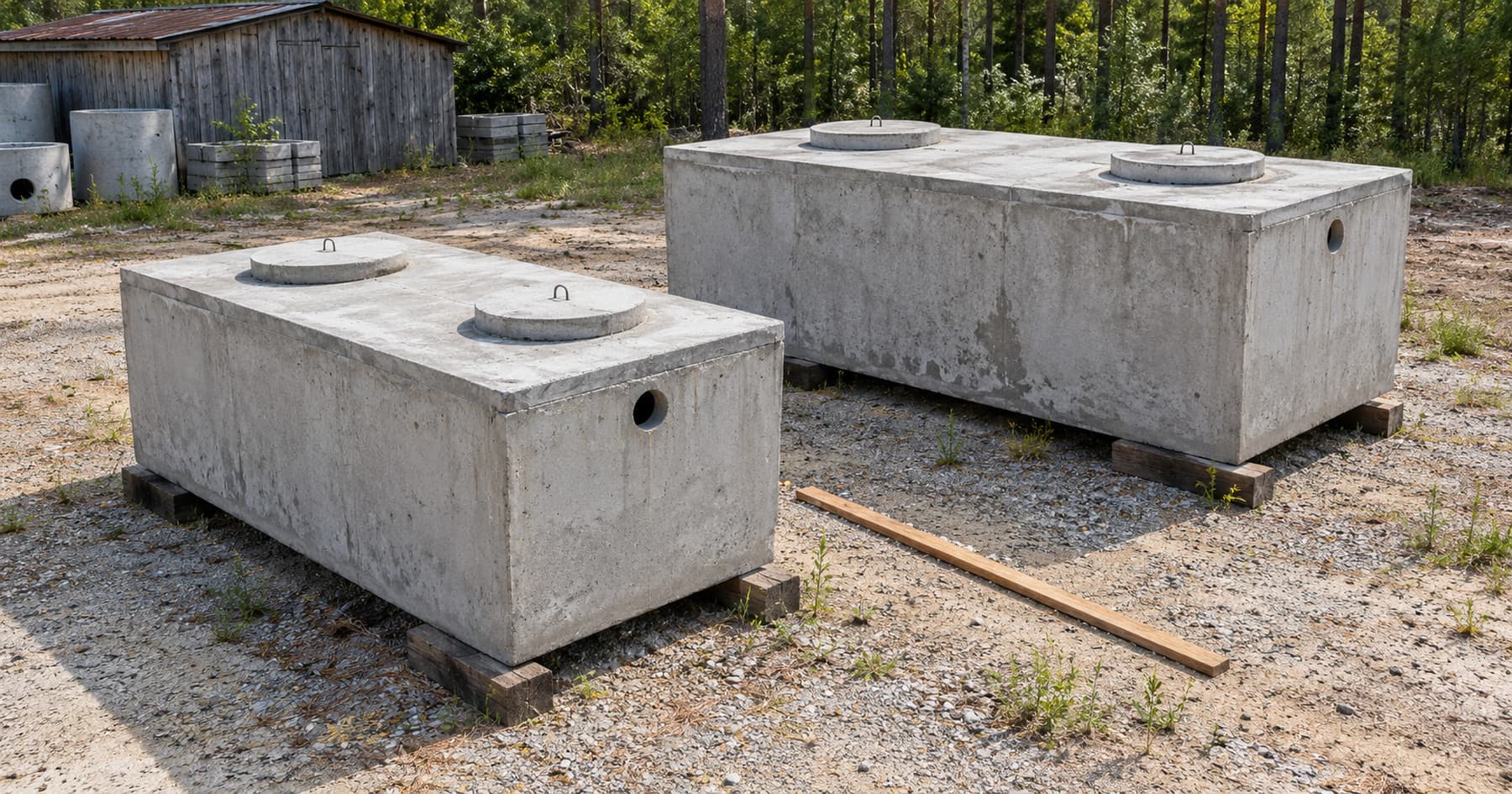
Concrete dominates Florida's septic market. Roughly 80% of new installations use precast concrete tanks, and there's good reason for it. Concrete resists floatation in high water table conditions without additional anchoring — a major advantage across much of the state. The weight that makes delivery difficult is the same property that keeps the tank from popping out of the ground when the water table rises.
Concrete tanks are manufactured by regional precasters across Florida, keeping prices competitive. In Hillsborough County and the Tampa Bay area, you'll find multiple suppliers within an hour's drive. Rural counties like Lafayette or Glades may add $200 to $500 in delivery surcharges due to distance.
The main drawback is weight. A 1,050-gallon concrete tank weighs around 4,500 pounds empty, requiring a boom truck or crane for placement. Sites with narrow access, overhead power lines, or steep slopes may need a lighter alternative.
Fiberglass Tanks
Fiberglass tanks weigh roughly one-tenth of their concrete equivalents, making them the go-to choice for difficult-access properties. They resist the hydrogen sulfide corrosion that slowly degrades concrete tanks in Florida's warm, humid conditions. Coastal properties in Lee County and Collier County sometimes prefer fiberglass for corrosion resistance.
The trade-off: fiberglass tanks can float. In areas with seasonal high water tables — common across South Florida — fiberglass tanks must be anchored to a concrete pad or fitted with anti-buoyancy straps. That anchoring adds $500 to $1,500 to the installation cost and requires careful engineering in counties like Broward and Palm Beach where the water table sits within 2 to 5 feet of the surface.
Polyethylene Tanks
Plastic tanks are the lightest and cheapest option, but they're less common in Florida than in northern states. The floatation risk is even greater than fiberglass, and the thinner walls can deform under soil pressure. FL DEP approves polyethylene tanks, but many contractors in high water table areas steer clients toward concrete instead. Where polyethylene works well: seasonal-use properties, elevated mound systems where the tank isn't buried deep, and sites where access truly rules out concrete.
High Water Table Impact on Tank Selection in South Florida
South Florida's water table creates challenges that don't exist in most other states. Across Miami-Dade, Broward, and Palm Beach counties, the seasonal high water table can sit within 6 to 24 inches of the ground surface during the wet season (June through October). That reality shapes every aspect of tank selection and sizing.
Buoyancy and Structural Concerns
An empty 1,050-gallon tank displaces over 140 cubic feet of soil. When groundwater rises above the bottom of the tank, buoyancy forces push upward. A lightweight fiberglass or plastic tank that's been pumped empty during wet season can literally float out of the ground — cracking inlet and outlet pipes, damaging the drain field connection, and turning a routine pumping into a $5,000 to $10,000 repair.
Concrete's weight provides natural resistance. A 4,500-pound concrete tank generates enough downforce to resist floatation in most Florida conditions without additional anchoring. For plastic and fiberglass, FL DEP and county environmental health offices typically require anchor straps connected to a poured-in-place concrete deadman or slab.
Sizing Adjustments for High Water Table Sites
When the water table limits the usable drain field depth, contractors sometimes oversize the tank to provide additional treatment time. A 4-bedroom home that would normally get a 1,250-gallon tank might receive a 1,500-gallon unit if the drain field has limited vertical separation from groundwater. The extra tank volume doesn't fix the drain field constraint, but it gives solids more settling time before effluent reaches the already-stressed absorption area.
In extreme cases — barrier islands, coastal lots in Monroe County, low-lying areas near the Everglades — conventional tanks and drain fields aren't viable at all. These sites require advanced treatment units (ATUs) or performance-based systems with their own sizing protocols that go beyond standard bedroom calculations.
ENR System Sizing in BMAP Springs Zones
If your property sits within a Basin Management Action Plan (BMAP) area near one of Florida's Outstanding Florida Springs, you're in a different sizing universe. The ENR-OSTDS (Enhanced Nutrient Reduction On-Site Treatment and Disposal System) requirement under Florida Senate Bill 712 and subsequent DEP rulemaking adds treatment modules that change the system footprint and tank configuration.
How ENR Sizing Differs
ENR systems must reduce nitrogen in effluent by at least 65% compared to conventional septic. This requires a multi-stage treatment process — typically a pretreatment tank, an aerobic treatment module, and a final polishing stage before the drain field. Each stage has its own volume requirements.
The primary tank in an ENR system still follows the standard bedroom-based sizing, but the total system volume (including all treatment stages) typically runs 1.5 to 2 times the conventional tank size. A 3-bedroom ENR system might use a 1,050-gallon primary tank plus a 500-gallon treatment module — 1,550 gallons of total tankage compared to 1,050 for conventional.
Where ENR Rules Apply
BMAP zones cover significant portions of North-Central Florida's springs corridor. Counties with the most affected properties include Alachua, Marion, Citrus, Levy, Suwannee, and Gilchrist. The karst geology in these areas means septic effluent can reach spring vents within months, making nitrogen reduction critical for water quality.
Before buying or building in the springs belt, check with your county DOH Environmental Health office to determine if the parcel falls within a BMAP zone. The cost difference is significant: conventional systems run $5,000 to $9,000 while ENR systems cost $20,000 to $35,000 installed. For a full breakdown, see our Florida septic installation cost guide.
Replacement Tank Sizing: What Changes When You Upgrade
Understanding florida septic tank size rules matters most during replacement. Replacing a failed or aging tank is rarely a one-for-one swap. Code requirements have tightened over the decades, and what was legal in 1985 may not meet current FL DEP standards.
Common Upsizing Scenarios
Older Florida homes often have undersized tanks by current standards. A 3-bedroom house built in the 1970s might have a 750 or 900-gallon tank. Current code requires 1,050 gallons minimum. If you're replacing the tank, the new one must meet current code — meaning a mandatory upsize.
The same applies if you've added bedrooms since the original installation. Converting a garage to a bedroom, finishing a bonus room, or adding a mother-in-law suite all increase the bedroom count for septic sizing purposes. The county will require documentation of current bedroom count during the permit process for a replacement tank.
When the Drain Field Needs to Match
Upsizing the tank sometimes triggers a drain field evaluation. If the existing drain field was designed for the old tank capacity and flow rate, it may not have the absorption area to handle increased flow from a larger tank serving more bedrooms. The county DOH site evaluator will determine whether the existing drain field can remain or needs expansion — a decision that can add $3,000 to $12,000+ to the project cost.
That said, if you're replacing a failed tank on the same bedroom count, the drain field usually remains as-is (assuming it's still functional). The upsize from, say, 900 to 1,050 gallons for a 3-bedroom home reflects code changes in minimum tank size, not an increase in actual wastewater flow.
Permit Requirements for Replacement
All septic tank replacements in Florida require a construction permit from the county DOH Environmental Health office. The permit fee runs $475 to $525 in most counties. A site evaluation may or may not be required depending on the scope of work — tank-only replacement on the same footprint sometimes qualifies for a streamlined review, while any change in system type, size increase, or drain field modification triggers a full evaluation.
Frequently Asked Questions
What size septic tank do I need for a 3-bedroom house in Florida?
Florida requires a minimum 1,050-gallon septic tank for a 3-bedroom house, based on an estimated 360 gallons per day of wastewater flow (120 GPD per bedroom). Most contractors recommend a 1,250-gallon tank if you have a garbage disposal or expect heavy water usage. The county DOH will confirm the required minimum during the permitting process.
Can I install a septic tank larger than the minimum in Florida?
Yes. FL DEP sets minimum sizes, not maximums. Installing a larger tank gives you more settling time for solids, longer intervals between pumpings, and better protection for your drain field. The added cost for going one size up — typically $200 to $500 for the tank itself — is well worth it for the reduced maintenance burden over 30+ years.
Does adding a bedroom require a larger septic tank in Florida?
Yes. Florida sizes septic systems by bedroom count. Adding a bedroom — whether through new construction, converting a den, or finishing a bonus room — increases the required tank capacity. You'll need a county DOH permit, and the system must be brought up to current code for the new bedroom count. If your current tank already meets the higher size requirement, you may not need a new tank, but the drain field capacity will still be evaluated.
How often should I pump my septic tank in Florida?
FL DEP recommends pumping every 3 to 5 years for most residential systems. The actual interval depends on tank size relative to household size. A 2-person household with a 1,250-gallon tank can stretch to 5 years comfortably. A family of 5 in a house with the minimum 1,050-gallon tank should pump every 2 to 3 years. Garbage disposals, water softener backwash, and heavy laundry use all shorten the cycle.
What happens if my septic tank is too small for my house?
An undersized tank pushes solids into the drain field before they've had time to settle. This clogs the soil absorption area over time, leading to slow drains, sewage surfacing in the yard, and eventually a full drain field failure. Replacing a failed drain field in Florida costs $5,000 to $15,000 — far more than the cost of installing a properly sized tank in the first place. If you suspect your tank is undersized, have it inspected and discuss upsizing with a licensed contractor.
Find Licensed Septic Contractors in Florida
Getting the florida septic tank size right starts with a contractor who knows your county's soil conditions, water table depths, and permitting requirements. A DEP-registered septic contractor will handle the site evaluation coordination, permit application, and installation to FL DEP standards.
Browse septic installation companies in Florida to find licensed contractors in your area. For a full cost breakdown of what installation runs by system type and region, see our Florida septic installation cost guide.
Find Florida providers
Connect with local professionals in Florida for your septic or well water needs.
Related reading
 state-guide
Well Drilling Depth South Carolina by Region
Well drilling depth south carolina ranges 30–400+ feet by region. Piedmont, Sandhills, Coastal Plain, and Lowcountry depths compared.
 state-guide
South Carolina Septic System Types
South carolina septic system types range from conventional gravity to drip dispersal. Compare costs and soil needs across all SC regions.
 state-guide
Septic Tank Size Guide: What Size Do You Need in NC?
What size septic tank do you need in NC? Use our guide to find the right tank capacity based on bedrooms, household size, and NC regulations.