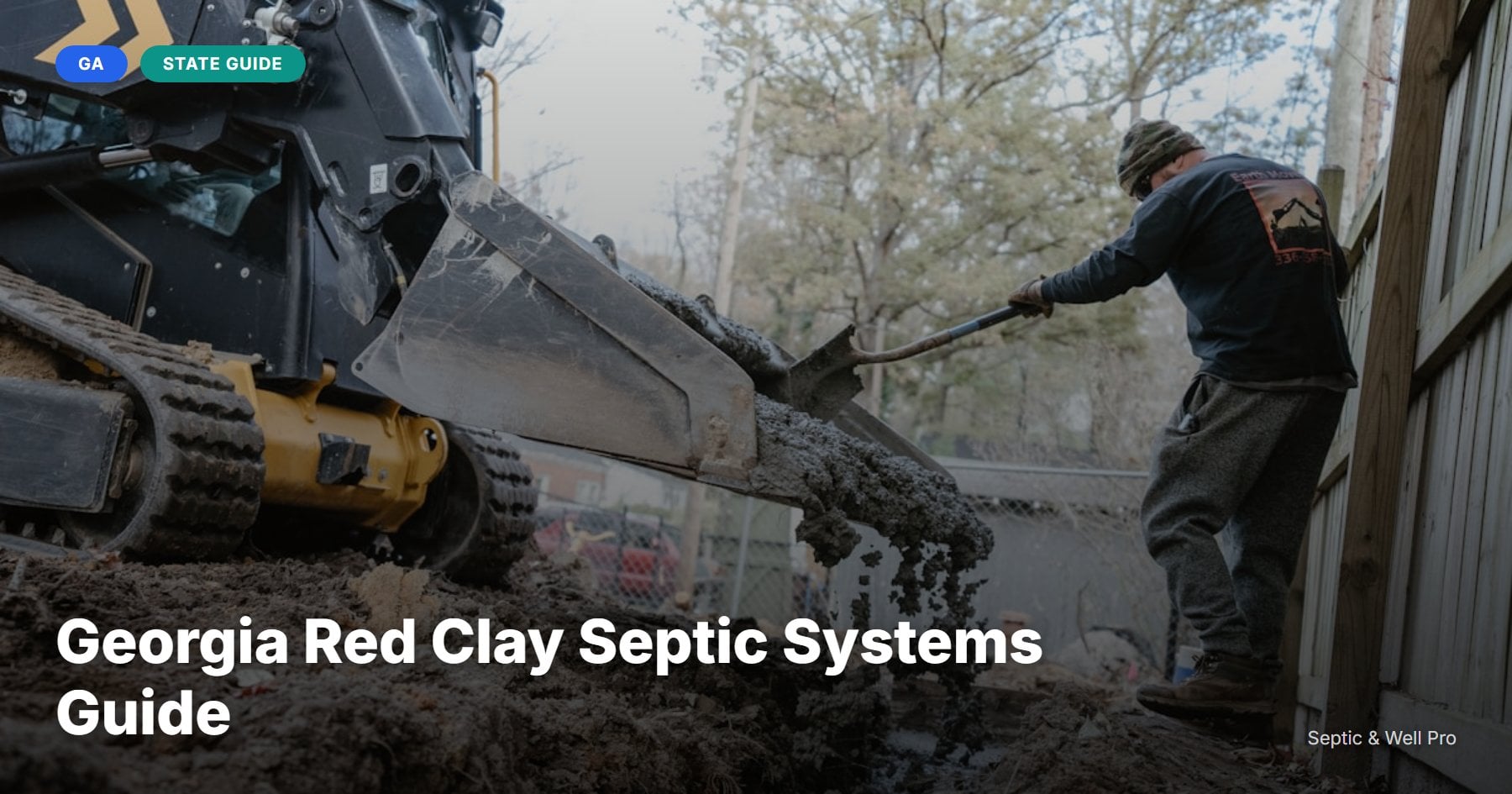
Georgia Red Clay Septic Systems Guide
Georgia red clay septic systems face unique drainage challenges in the Piedmont region. Learn which system types work and how to maintain them.
Georgia red clay septic systems face challenges that homeowners in sandy or loamy soil never think about. The Piedmont region stretching from the Blue Ridge foothills through metro Atlanta and down to the fall line is dominated by dense, iron-rich clay that drains slowly and becomes nearly impervious when saturated. If you own property on this red clay — and millions of Georgians do — your septic system requires a different approach to installation, maintenance, and problem-solving.
The Piedmont covers some of Georgia's fastest-growing counties: Forsyth, Cherokee, Gwinnett, Hall, Barrow, and Jackson. Thousands of new homes go in every year on clay soils, and each one needs a septic system designed for the conditions. Understanding the relationship between red clay and your septic system is not academic — it directly affects your property value and your daily plumbing.
Why Georgia Red Clay Septic Systems Struggle
Clay particles are the smallest soil particle type — roughly 1,000 times smaller than sand grains. When wet, they swell and pack together tightly, leaving almost no pore space for water to pass through. Georgia's Piedmont clay typically percolates at rates of 60 minutes per inch or slower, compared to 5 to 15 minutes per inch for sandy soils in the Coastal Plain.
That slow percolation creates a cascade of problems for septic systems. Effluent leaving the tank enters the drain field but cannot absorb into the surrounding clay fast enough. The trenches stay saturated. The biological mat that normally helps treat effluent grows too thick because the aerobic-anaerobic cycle is disrupted. Eventually the system fails — effluent surfaces in the yard or backs up into the house.
Seasonal factors make it worse. Georgia's heaviest rainfall hits in spring, exactly when the water table is highest and the clay is already saturated from winter moisture. A system that handles summer loads fine may fail during a wet March or April.
Red Clay Septic Problems GA: Common Failure Patterns
Specific red clay septic problems GA homeowners see fall into predictable patterns.
Seasonal drain field failure. The system works during dry months but shows stress — slow drains, soggy ground, odors — during wet seasons. This is the classic clay signature. The drain field cannot keep up when the surrounding soil is already holding as much water as it can.
Premature biomat clogging. The biological mat at the trench-soil interface grows thicker in clay because the soil stays wet longer. A biomat that would be manageable in sandy soil becomes a seal in clay, blocking all absorption. Conventional systems on Piedmont clay may develop critical biomat problems in 10 to 15 years versus 20 to 25 years on better soils.
Surface breakout. When the drain field cannot absorb effluent, the wastewater finds the path of least resistance — usually upward through the soil to the surface. You see this as wet patches, unusually green grass, or visible wastewater pooling over the drain field area.
Compaction damage. Clay is especially vulnerable to compaction. Driving a vehicle across the drain field area just once can compress the soil to the point where it never recovers its drainage capacity. This is irreversible damage — the compacted clay essentially becomes a liner that blocks all absorption.
Piedmont Clay Septic System Types That Work
The good news is that several system types handle piedmont clay septic system conditions effectively. Your county health department determines which options are viable for your specific property based on the soil evaluation.
Mound systems ($10,000–$20,000). Built above the natural grade with imported fill material (sand), mound systems create an engineered absorption bed on top of the clay. Effluent is pumped up into the mound where it filters through the sand before reaching the native soil. Mounds are the most common alternative system on Georgia Piedmont clay.
Aerobic treatment units ($10,000–$20,000). ATUs pre-treat effluent to a much higher quality before it reaches the drain field. The cleaner effluent requires less soil absorption capacity, making ATUs effective even on tight clay soils. They require ongoing maintenance including annual inspections and air pump servicing.
Low-pressure pipe systems ($8,000–$14,000). LPP systems distribute effluent evenly across a larger drain field area through pressurized pipes with small orifices. This prevents the concentrated loading that overwhelms conventional gravity-fed trenches in clay. The wider distribution gives the clay more time to absorb effluent.
Drip irrigation systems ($8,000–$18,000). The most advanced option distributes tiny amounts of pre-treated effluent through drip emitters buried 6 to 12 inches deep over a wide area. Drip systems work on virtually any soil type because the doses are so small that even clay can absorb them. They require a pre-treatment step and more maintenance than conventional systems.
Chamber systems ($7,000–$12,000). Plastic chambers replace traditional gravel-filled trenches. The open bottom of the chamber allows effluent to contact a larger soil surface area. In moderately difficult clay, chambers can outperform conventional trenches by 20% to 30% in terms of absorption rate.
Septic System Clay Soil Georgia: Maintenance Tips
Maintaining a septic system clay soil georgia properties depend on requires more attention than systems on forgiving soils. The margin for error is smaller.
- Pump more frequently. Every 2 to 3 years instead of the standard 3 to 5. Keeping sludge levels low reduces the chance of solids reaching the already-challenged drain field.
- Spread water use across the week. Never run multiple water-intensive appliances simultaneously. One load of laundry per day instead of four on Saturday morning. Clay drain fields need recovery time between loading events.
- Divert all surface water away from the drain field. Gutters, downspouts, driveway runoff, and grading should all direct water away from the drain field area. Every gallon of rainwater that reaches the drain field is a gallon the system did not need to process.
- Never drive on the drain field. Even once. Clay compacts easily and does not recover. Mark the drain field boundaries so contractors, delivery trucks, and guests know where not to drive.
- Keep the effluent filter clean. On clay soils, even small amounts of solids reaching the drain field accelerate failure. Clean the filter annually — more often if you notice slow drains.
- Plant grass, nothing else. Grass transpires moisture from the soil and keeps it from becoming waterlogged. Trees and deep-rooted plants invade drain field pipes. The best practice for Piedmont clay is a well-maintained grass cover with no trees within 30 feet.
Find contractors experienced with Piedmont clay septic systems through our Georgia septic installation directory. For pumping services, visit our Georgia septic pumping directory. Read our Georgia septic regulations guide for permit requirements.
Frequently Asked Questions
Can a conventional septic system work in Georgia red clay?
It depends on the specific clay characteristics. Some Piedmont locations have clay with acceptable percolation rates for conventional gravity systems. Many do not. The county site evaluation determines what is feasible. If the perc rate exceeds 60 minutes per inch, conventional systems are off the table and you will need an alternative design.
How much more does a septic system cost in Georgia red clay?
Alternative systems required for clay typically cost $10,000 to $20,000 compared to $6,000 to $8,000 for conventional systems on good soil. The premium is $4,000 to $14,000 depending on the alternative type. Mound systems are the most common and generally fall in the $10,000 to $15,000 range on Piedmont clay.
Does red clay affect well water quality in Georgia?
Clay itself does not contaminate well water. However, the poor drainage associated with clay can increase the risk of surface contaminants reaching shallow wells during heavy rain. Deep wells drilled through the clay into bedrock typically produce clean water, though iron and manganese are common in the Piedmont. Regular well water testing is always recommended.
Will my drain field last as long on red clay?
Drain fields on Piedmont clay typically last 15 to 25 years with proper maintenance, versus 20 to 30 years on sandy or loamy soils. More frequent pumping, careful water management, and avoiding compaction extend the lifespan. Systems that are undersized or poorly maintained on clay may fail in as few as 10 years.
Find Georgia providers
Connect with local professionals in Georgia for your septic or well water needs.
Related reading
 state-guide
Well Drilling Depth South Carolina by Region
Well drilling depth south carolina ranges 30–400+ feet by region. Piedmont, Sandhills, Coastal Plain, and Lowcountry depths compared.
 state-guide
South Carolina Septic System Types
South carolina septic system types range from conventional gravity to drip dispersal. Compare costs and soil needs across all SC regions.
 state-guide
Septic Tank Size Guide: What Size Do You Need in NC?
What size septic tank do you need in NC? Use our guide to find the right tank capacity based on bedrooms, household size, and NC regulations.