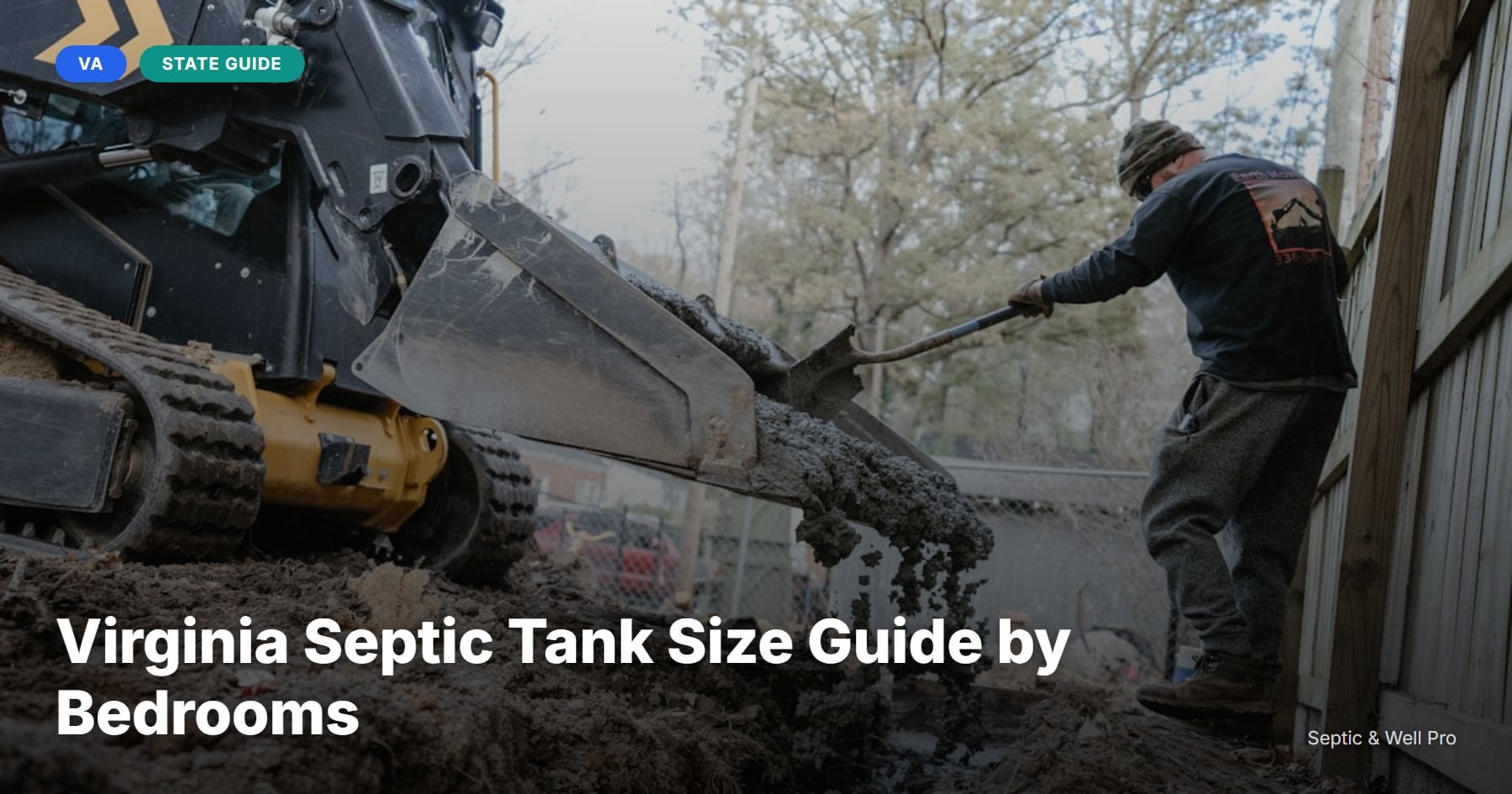
Virginia Septic Tank Size Guide by Bedrooms
Virginia septic tank size requirements by number of bedrooms. See VDH minimums, regional factors, and cost differences.
Getting the virginia septic tank size right is one of the most consequential decisions in any new septic installation. Too small, and the system will struggle to handle your household's wastewater — leading to premature drain field failure, backups, and expensive repairs. Too large, and you are paying for capacity you do not need. Virginia's Department of Health (VDH) sets minimum tank size requirements under 12VAC5-610 based on the number of bedrooms in your home, and understanding those requirements protects both your investment and your property.
Virginia's regulations tie tank size to bedroom count rather than actual occupancy because bedrooms represent a property's maximum potential load. A three-bedroom home could house anywhere from one person to six, and the system must handle the worst-case scenario. Here is exactly what the state requires and how regional factors affect your final sizing decision.
Virginia Septic Tank Size Requirements by Bedroom Count
The VDH minimum tank sizes under 12VAC5-610 apply to all new installations and most replacements across Virginia's 35 health districts. These are minimums — your soil evaluator or system designer may recommend a larger tank based on site-specific conditions.
| Bedrooms | VDH Minimum Tank Size (gallons) | Estimated Daily Flow (gpd) | Typical Cost Range |
|---|---|---|---|
| 1–2 | 750 | Up to 300 | $800–$1,500 |
| 3 | 1,000 | Up to 450 | $1,000–$2,000 |
| 4 | 1,250 | Up to 600 | $1,300–$2,500 |
| 5 | 1,500 | Up to 750 | $1,600–$3,000 |
| 6+ | 1,500+ (add 250 gal per bedroom) | 750+ | $2,000+ |
These costs cover the tank itself — a precast concrete unit in most Virginia installations. Total system cost including the drain field, piping, permit, and labor runs significantly higher. See our guide to septic installation costs in Virginia for full project pricing.
Why Virginia Sizes Tanks by Bedrooms, Not Occupants
The bedroom-based approach under 12VAC5-610 reflects a practical reality: occupancy changes over a home's lifetime, but bedrooms do not (without a building permit). A couple buying a three-bedroom home today might have three children within five years, and the septic tank size Virginia regulations require must handle that future load without modification.
This also simplifies enforcement. VDH inspectors and DPOR-licensed soil evaluators can verify bedroom count from building permits and floor plans. Tracking actual occupancy over time would be impractical and unenforceable. The VA septic tank size requirements use bedrooms as a reliable, verifiable proxy for maximum wastewater generation.
One common question: does a home office or bonus room count as a bedroom? Under Virginia building code, a room counts as a bedroom if it has a closet, a window for egress, and meets minimum size requirements. If your floor plan shows a room that could function as a bedroom, the VDH will likely size the system accordingly.
Regional Factors That Affect Tank Sizing in Virginia
While the VDH minimums apply statewide, several regional factors can push your actual virginia septic tank capacity needs above the minimum:
Coastal Plain (Tidewater, Hampton Roads, Eastern Shore)
High water tables and sandy soils in the Coastal Plain mean tanks must be engineered to resist buoyancy when empty or partially full. Concrete tanks are standard because their weight resists flotation. Some installers in the Chesapeake and Virginia Beach area recommend going one size above the VDH minimum to provide extra settling capacity in a region where the drain field already works harder due to saturated soils.
Piedmont (Northern Virginia, Central Virginia)
Slow-draining clay soils in the Piedmont benefit from larger tanks because extended settling time reduces the solids load reaching the drain field. Since the drain field is often the weak link in Piedmont installations (clay resists percolation), a bigger tank acts as insurance. Many installers in Loudoun and Fauquier counties routinely install 1,250-gallon tanks for three-bedroom homes even though 1,000 gallons meets the minimum.
Valley and Ridge (Shenandoah Valley)
Karst limestone terrain in the Valley creates a different concern: groundwater protection. Larger tanks with longer retention times allow more settling and anaerobic treatment before effluent reaches the drain field. In areas with known sinkholes or shallow karst, the VDH health district may require a larger tank or a two-compartment design as a condition of the construction permit.
Blue Ridge and Mountain Counties
Shallow bedrock and steep slopes can limit tank installation options. Concrete tanks must be placed on stable, level ground, and the excavation may require rock removal. Tank access for future pumping must also be considered on steep sites — a 1,500-gallon tank that sits 200 feet downhill from the nearest truck-accessible point will be expensive to pump.
Septic Tank Size Bedrooms Virginia: Upgrade Scenarios
Several situations call for exceeding the VDH minimum septic tank size bedrooms Virginia tables specify:
Adding bedrooms. If you are converting a bonus room, finishing a basement bedroom, or adding an accessory dwelling unit (ADU), the existing tank may not meet the new bedroom count minimum. The VDH will require a tank upgrade or replacement as a condition of the building permit modification.
Home-based businesses. A home salon, daycare, or Airbnb that significantly increases water usage may require an upsized tank and drain field. The VDH evaluates these on a case-by-case basis through the local health district.
High-efficiency fixtures. Paradoxically, low-flow toilets and high-efficiency washing machines can actually cause problems in undersized tanks. Reduced water volume means less flushing of the tank, leading to heavier sludge accumulation. The fix is not to waste water — it is to size the tank appropriately and pump on schedule.
Garbage disposals. If your household uses a garbage disposal, the VDH and most DPOR-licensed designers recommend increasing tank capacity by 25 to 50 percent above the minimum. Garbage disposals introduce food solids that accelerate sludge buildup significantly.
Tank Materials Used in Virginia
Precast concrete is the overwhelming standard for virginia septic tank installations. Concrete tanks are durable, heavy (which resists buoyancy in high water table areas), and available from local precast plants across the state. A 1,000-gallon precast concrete tank typically costs $1,000 to $1,800 delivered.
Plastic (polyethylene) tanks are lighter and easier to transport to difficult sites, but they require anchoring straps in high water table areas to prevent flotation. Some western Virginia installers prefer plastic tanks for mountain properties where access roads make heavy concrete delivery impractical.
Fiberglass tanks exist but are uncommon in Virginia. They cost more than both concrete and plastic with no significant performance advantage for residential installations.
Frequently Asked Questions
What is the minimum septic tank size for a 3-bedroom home in Virginia?
The VDH minimum under 12VAC5-610 is 1,000 gallons for a three-bedroom home. This is the most common residential tank size in Virginia. Many installers recommend 1,250 gallons for three-bedroom homes on clay soils in the Piedmont to provide extra settling capacity and reduce drain field stress.
Can I install a septic tank larger than the Virginia minimum?
Yes. The VDH sets minimums, not maximums. Installing a larger tank is always permitted and often recommended. A bigger tank provides longer settling time, reduces pumping frequency, and puts less stress on the drain field. The additional cost of going one size up is usually $200 to $500 — a worthwhile investment over a 30-year system lifespan.
Does adding a bedroom require a new septic tank in Virginia?
It depends on your current tank size relative to the new bedroom count minimum. If your existing tank already meets or exceeds the VDH minimum for the new bedroom count, no tank replacement is needed. If it falls short, the VDH health district will require a tank upgrade as part of the building permit process. A DPOR-licensed installer can assess your current system before you begin the addition.
How does a garbage disposal affect septic tank sizing?
Garbage disposals introduce food waste that significantly increases sludge accumulation. VDH and most Virginia installers recommend increasing tank capacity by 25 to 50 percent if the household uses a garbage disposal. This means a three-bedroom home might need a 1,250 or 1,500-gallon tank instead of the standard 1,000-gallon minimum. More frequent pumping — every two to three years instead of three to five — also helps.
Find Septic Installation Professionals in Virginia
Getting the right virginia septic tank size starts with a proper soil evaluation by a DPOR-licensed evaluator. The evaluator's findings combined with your home's bedroom count determine the tank and system specifications for your VDH permit application. Browse Virginia septic installation professionals in our directory to find licensed installers and soil evaluators near you.
For questions about your existing tank size, a Virginia septic inspection can verify tank capacity and condition before you commit to repairs or replacement.
Find Virginia providers
Connect with local professionals in Virginia for your septic or well water needs.
Related reading
 state-guide
Well Drilling Depth South Carolina by Region
Well drilling depth south carolina ranges 30–400+ feet by region. Piedmont, Sandhills, Coastal Plain, and Lowcountry depths compared.
 cost-guide
Well Pump Repair Cost Virginia (2026)
Well pump repair cost virginia homeowners pay ranges $300–$2,000+. Full pricing by repair type, region, and pump depth.
 city-guide
Best Septic Companies Suffolk VA (2026)
Best septic companies Suffolk VA homeowners rely on for pumping, CBPA compliance, inspections, and rural system repair.